
At the base chart, change coordinates by \(D=\operatorname{diag}(2,1)\). Transform every connection edge by the prescribed endpoint gauges. The loop transforms by conjugation, giving
The shear looks stronger in these fixed numerical axes, but the verdict on flatness is unchanged by gauge.
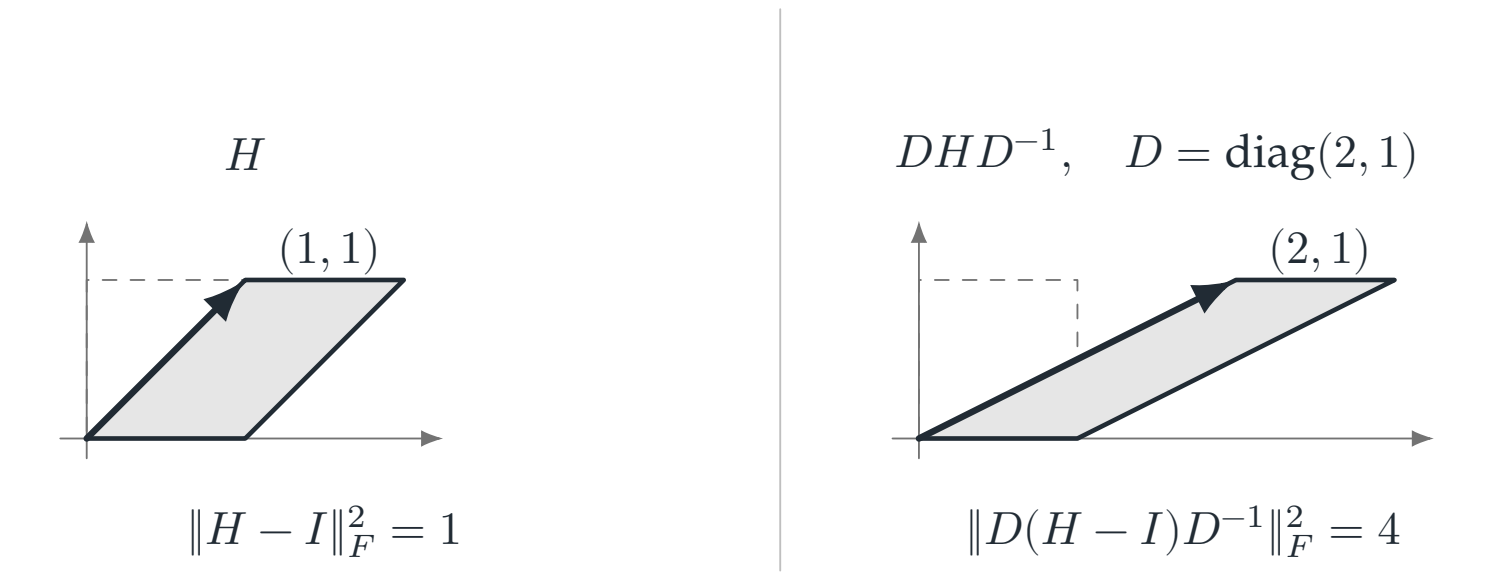
Reading the drawing
Both shapes are exact images of a unit square under the displayed matrices. The nonorthogonal gauge changes the coordinate norm of the obstruction while preserving nonflatness.
Drawing labels and data 6 labels
Read the original labels as selectable text. Tables preserve grid relationships; other short labels are grouped compactly.
- \(H\)
- \((1,1)\)
- \(DHD^{-1},\quad D=\operatorname{diag}(2,1)\)
- \((2,1)\)
- \(\|H-I\|_F^2=1\)
- \(\|D(H-I)D^{-1}\|_F^2=4\)
Evidence note from the source edition
Both figures are exact images of a unit square under their displayed matrices. The Frobenius norms are computed in the indicated fixed coordinate bases. A nonorthogonal gauge need not preserve such a norm.
The rank of the obstruction is one on both sides. Trace, determinant, and characteristic polynomial are preserved under this conjugation. Most importantly,
An invertible coordinate change cannot turn a nonidentity loop into the identity. The fact that a particular residual norm changes does not contradict the invariance of exact vanishing.
The base chart determines the outer gauge
In a triangle product, adjacent intermediate gauges cancel:
Only the base gauge survives around the loop. For the additive defect, the surviving outer gauges instead belong to its different source and target fibers.
Read this as
Exact nonvanishing is gauge invariant. The numerical size of a matrix entry or a chosen norm generally is not.