
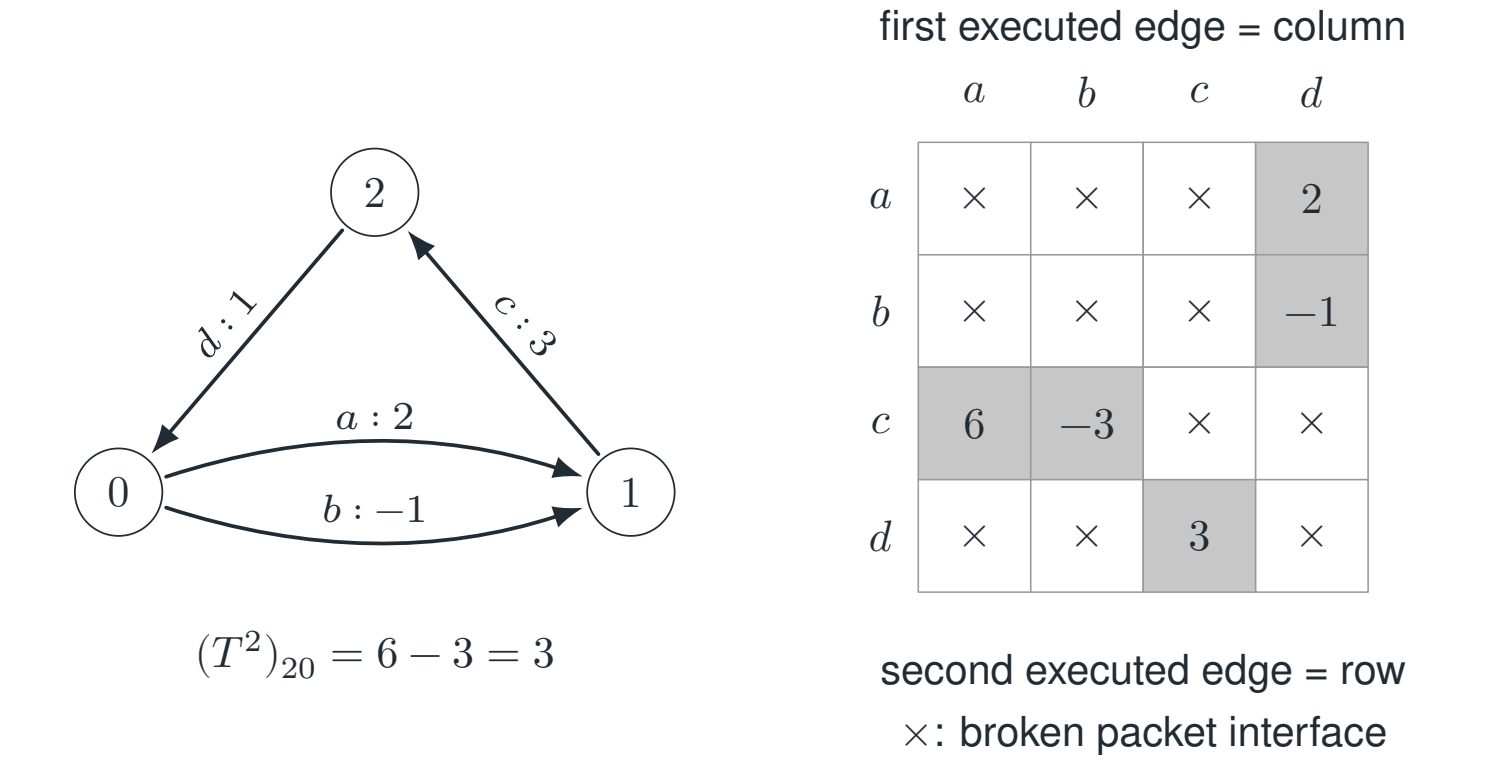
Add four edges on three packets: \(a:0\to1\) with coefficient \(2\), \(b:0\to1\) with coefficient \(-1\), \(c:1\to2\) with coefficient \(3\), and \(d:2\to0\) with coefficient \(1\). The parallel edges \(a\) and \(b\) are separate labels even though their source and target agree.
Reading the drawing
Columns give the first edge and rows the second. Crosses mark incompatible interfaces; the five surviving cells retain their signed coefficients and parallel edge labels.
Drawing labels and data 35 labels
Read the original labels as selectable text. Tables preserve grid relationships; other short labels are grouped compactly.
- \(0\)
- \(1\)
- \(2\)
- \(a:2\)
- \(b:-1\)
- \(c:3\)
- \(d:1\)
- \((T^2)_{20}=6-3=3\)
| Row / column | \(a\) | \(b\) | \(c\) | \(d\) |
|---|---|---|---|---|
| \(a\) | \(\times\) | \(\times\) | \(\times\) | \(2\) |
| \(b\) | \(\times\) | \(\times\) | \(\times\) | \(-1\) |
| \(c\) | \(6\) | \(-3\) | \(\times\) | \(\times\) |
| \(d\) | \(\times\) | \(\times\) | \(3\) | \(\times\) |
- first executed edge = column
- second executed edge = row
- \(\times\): broken packet interface
Evidence note from the source edition
The board tests all ordered pairs. Columns are the first executed edge and rows are the second. A shaded cell gives the ordered coefficient of a valid walk. A cross means the product is zero by type mismatch.
The surviving words are \(ac,bc,cd,da,db\). Their coefficients are \(6,-3,3,2,-1\), respectively. Their endpoints determine where these numbers enter the matrix:
At row \(2\), column \(0\), the two parallel choices give \(6-3=3\). Deduplicating the edge labels before summing would alter the operator. On the other hand, adding the parallel coefficients in the already assembled matrix is legitimate: both act in the same supported matrix position.
The same calculation extends from pairs to all finite words by distributivity. The included check enumerates every word through length six and independently accumulates the endpoint coefficients. The empty word is treated separately as the identity.
Read this as
The matrix power is a signed, ordered walk sum. It is not simply the number of paths, and a graph edge is not identified solely by its endpoints.