
Keep the diamond and add an isolated packet \(4\). Start with the single seed \(e_0\in{\mathbb Q}^5\). Direct multiplication gives
Every later orbit vector is zero. The orbit hull generated by \(T\) is therefore exactly the span of the first two displayed columns.
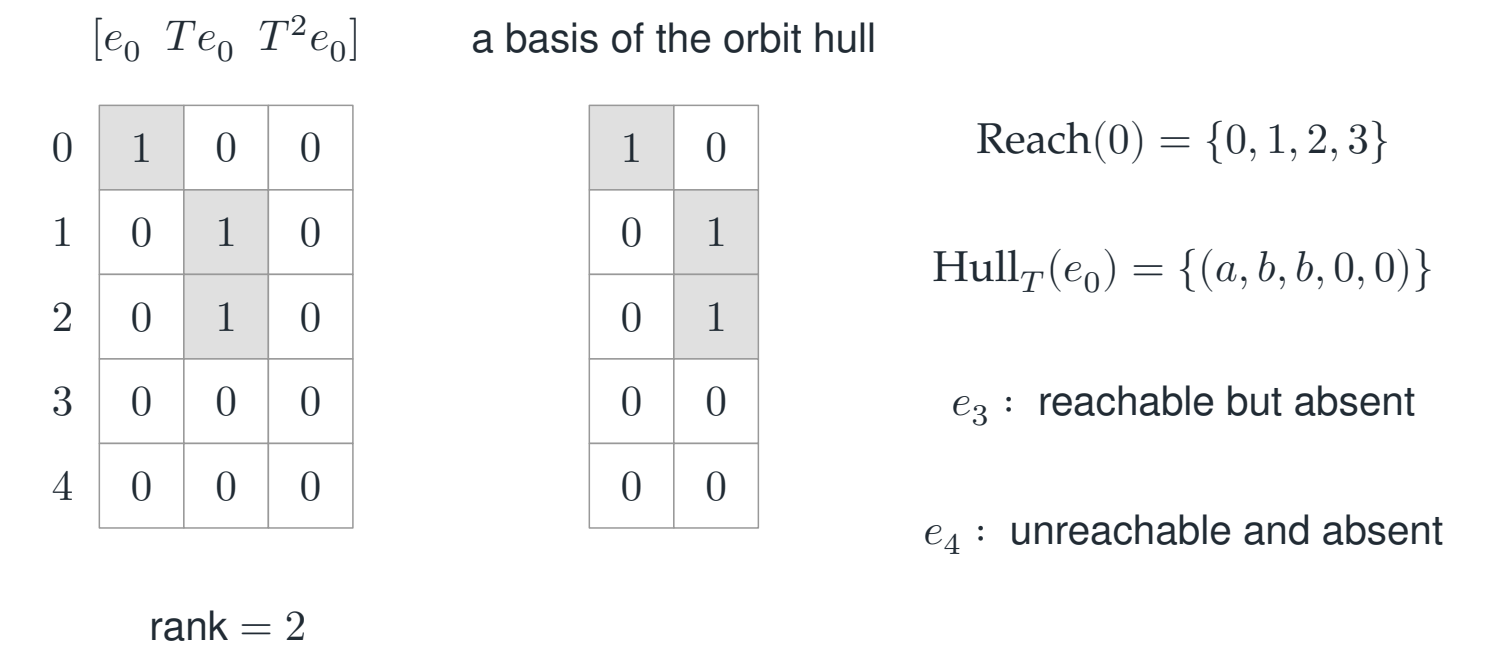
Reading the drawing
The first matrix lists actual orbit columns and the second a basis of their span. Four reachable coordinates contain only a two-dimensional orbit hull.
Drawing labels and data 37 labels
Read the original labels as selectable text. Tables preserve grid relationships; other short labels are grouped compactly.
- \([e_0\ \ Te_0\ \ T^2e_0]\)
| Row / column | Column 1 | Column 2 | Column 3 |
|---|---|---|---|
| \(0\) | \(1\) | \(0\) | \(0\) |
| \(1\) | \(0\) | \(1\) | \(0\) |
| \(2\) | \(0\) | \(1\) | \(0\) |
| \(3\) | \(0\) | \(0\) | \(0\) |
| \(4\) | \(0\) | \(0\) | \(0\) |
- rank \(=2\)
- a basis of the orbit hull
| Row / column | Column 1 | Column 2 |
|---|---|---|
| Row 1 | \(1\) | \(0\) |
| Row 2 | \(0\) | \(1\) |
| Row 3 | \(0\) | \(1\) |
| Row 4 | \(0\) | \(0\) |
| Row 5 | \(0\) | \(0\) |
- \(\operatorname{Reach}(0)=\{0,1,2,3\}\)
- \(\operatorname{Hull}_T(e_0)=\{(a,b,b,0,0)\}\)
- \(e_3:\ \text{reachable but absent}\)
- \(e_4:\ \text{unreachable and absent}\)
Evidence note from the source edition
The first matrix contains the actual orbit columns. The second supplies a basis of their span. The orbit hull lies inside the reachable subspace on four coordinates, but it has dimension two, not four.
A vector belongs to this hull precisely when it has the form
Packet \(4\) is excluded because it is unreachable. Packet \(3\) is also absent, but for a different reason: the two contributions cancel. Even the reachable packets \(1\) and \(2\) remain linked. Powers of the single total operator do not separate them.
The admissible operator grammar matters
Allowing each individual edge operator is a different generation problem. For instance, applying the edge \(0\to1\) and then \(1\to3\) individually produces \(e_3\). It does not follow that \(e_3\) belongs to the orbit of the summed operator \(T\). The paper's theorem on orbit support concerns the explicitly stated operator action.
Read this as
Unreachable means impossible under the declared action. Reachable means only that graph geometry has not ruled it out. Linear dependence and cancellation still have to be checked.