
Supply a reversible connection on three copies of \({\mathbb Q}^2\) by choosing
and declaring every reverse edge to be the inverse. This time both nontrivial forward matrices are retained.
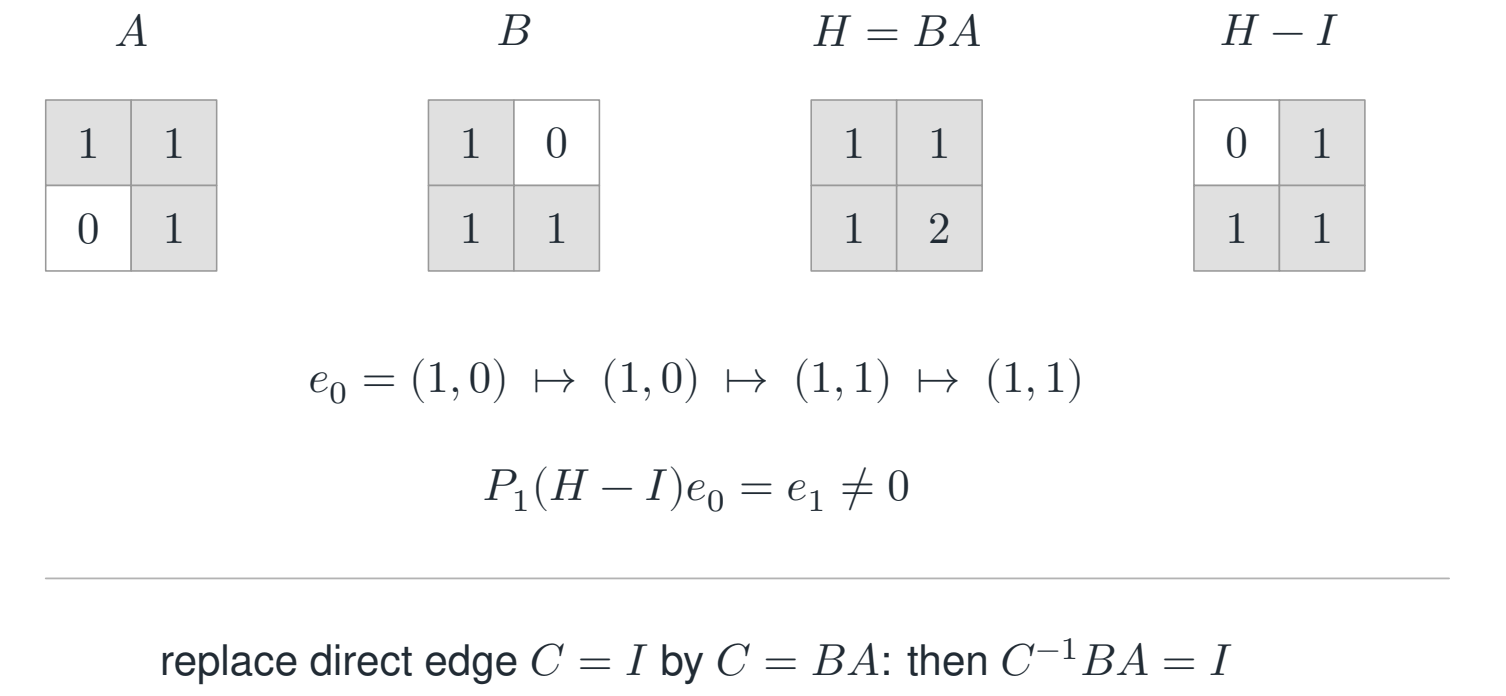
Reading the drawing
The vector row follows the source through the first matrix, the second and the inverse comparison map. Its final displacement supplies the named nonzero packet witness.
Drawing labels and data 23 labels
Read the original labels as selectable text. Tables preserve grid relationships; other short labels are grouped compactly.
- \(A\)
| Row / column | Column 1 | Column 2 |
|---|---|---|
| Row 1 | \(1\) | \(1\) |
| Row 2 | \(0\) | \(1\) |
- \(B\)
| Row / column | Column 1 | Column 2 |
|---|---|---|
| Row 1 | \(1\) | \(0\) |
| Row 2 | \(1\) | \(1\) |
- \(H=BA\)
| Row / column | Column 1 | Column 2 |
|---|---|---|
| Row 1 | \(1\) | \(1\) |
| Row 2 | \(1\) | \(2\) |
- \(H-I\)
| Row / column | Column 1 | Column 2 |
|---|---|---|
| Row 1 | \(0\) | \(1\) |
| Row 2 | \(1\) | \(1\) |
- \(P_1(H-I)e_0=e_1\ne0\)
replace direct edge \(C=I\) by \(C=BA\): then \(C^{-1}BA=I\)
Evidence note from the source edition
The vector row starts with the source witness \(e_0\) and follows it through \(A\), then \(B\), then \(C^{-1}\). Returning to the base produces \((1,1)^\mathsf T\), whose displacement from the input is \(e_1\).
The calculation gives
Choose the standard packet projectors. The \((1,0)\) block is nonzero, and the explicit candidate vector satisfies \(P_1(H-I)e_0=e_1\). This proves nonflatness of the supplied connection at the supplied triangle.
Repairing data is not the same as changing gauge
Replacing the direct map \(C=I\) by \(C=BA\), and updating its reverse, makes the new loop equal to \(I\). That changes the connection. It cannot be a gauge of the original nonflat connection, because gauge preserves whether holonomy is the identity. For this complete example on three charts all cocycles then hold. Changing one edge in a larger network would require checking the other affected loops as well.
Read this as
Declare the data, multiply in traversal order, form the defect, resolve all blocks, and exhibit an input on which one block acts nontrivially. Each step has a checkable mathematical object.