
Put \(\Gamma_{1\leftarrow0}=H\), \(\Gamma_{2\leftarrow1}=I\), and \(\Gamma_{2\leftarrow0}=I\), with reverse maps given by inverses, where
The loop \(0\to1\to2\to0\) then has exactly this shear as its holonomy.
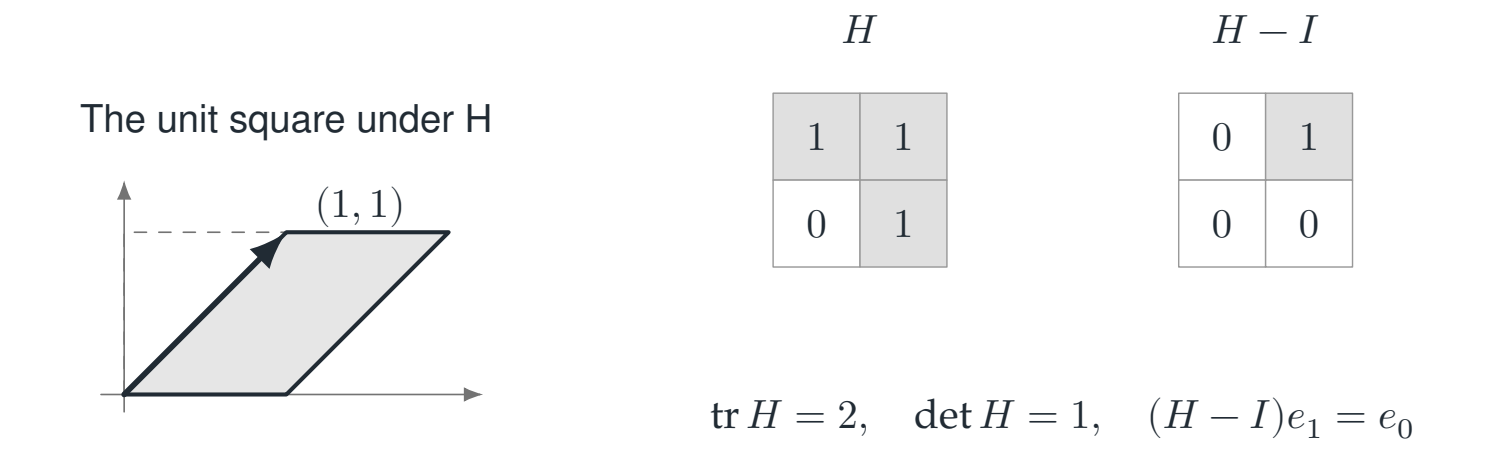
Reading the drawing
A dashed square and its solid parallelogram image display the nonidentity shear. One basis vector moves even though trace and determinant match the identity.
Drawing labels and data 13 labels
Read the original labels as selectable text. Tables preserve grid relationships; other short labels are grouped compactly.
- The unit square under H
- \((1,1)\)
- \(H\)
| Row / column | Column 1 | Column 2 |
|---|---|---|
| Row 1 | \(1\) | \(1\) |
| Row 2 | \(0\) | \(1\) |
- \(H-I\)
| Row / column | Column 1 | Column 2 |
|---|---|---|
| Row 1 | \(0\) | \(1\) |
| Row 2 | \(0\) | \(0\) |
Evidence note from the source edition
The dashed square is the original set. The solid parallelogram is its exact image. The second coordinate basis vector moves to \((1,1)^\mathsf T\). Its nonzero displacement is the first basis vector.
The usual scalar invariants can be misleading:
These are also the invariants of the \(2\times2\) identity matrix. Nevertheless,
A complete obstruction test must therefore retain the operator or a certificate strong enough to detect its nonzero action. Trace, determinant, and eigenvalue lists alone do not distinguish this loop from the identity.
What the picture certifies, and what it does not
The plotted corners are the images of the four corners of the unit square under the displayed matrix. The equation \({\operatorname{Ob}} e_1=e_0\) is the exact witness. No smooth connection, curvature tensor, or continuum limit is used in this model. Its holonomy is the finite algebraic loop product. The traditional paper treats smooth transport separately under additional hypotheses.
Read this as
Flatness is the equality \(H=I\), not agreement of a short list of spectral summaries. A single explicit moved vector can disprove that equality.