
Here the packet lists have sizes \(2,3,2,1\) in succession. Let the actual maps be
Unlike a power of one matrix, each step has its own entries and its own source and target list.
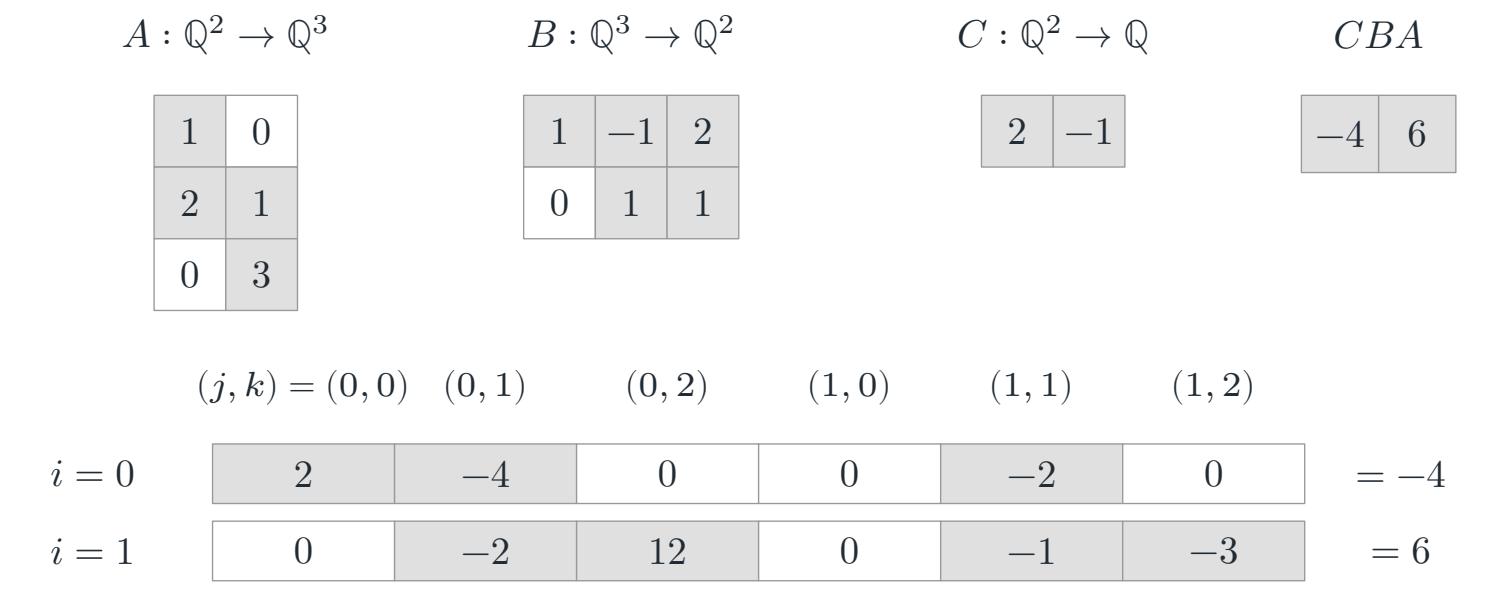
Reading the drawing
The lower board retains every choice of intermediate indices for one final row. Its cells include zero contributions and use the displayed rectangular matrix sizes.
Drawing labels and data 42 labels
Read the original labels as selectable text. Tables preserve grid relationships; other short labels are grouped compactly.
- \(A:{\mathbb Q}^2\to{\mathbb Q}^3\)
| Row / column | Column 1 | Column 2 |
|---|---|---|
| Row 1 | \(1\) | \(0\) |
| Row 2 | \(2\) | \(1\) |
| Row 3 | \(0\) | \(3\) |
- \(B:{\mathbb Q}^3\to{\mathbb Q}^2\)
| Row / column | Column 1 | Column 2 | Column 3 |
|---|---|---|---|
| Row 1 | \(1\) | \(-1\) | \(2\) |
| Row 2 | \(0\) | \(1\) | \(1\) |
- \(C:{\mathbb Q}^2\to{\mathbb Q}\)
- \(2\)
- \(-1\)
- \(CBA\)
- \(-4\)
- \(6\)
| Row / column | \((j,k)=(0,0)\) | \((0,1)\) | \((0,2)\) | \((1,0)\) | \((1,1)\) | \((1,2)\) |
|---|---|---|---|---|---|---|
| \(i=0\) | \(2\) | \(-4\) | \(0\) | \(0\) | \(-2\) | \(0\) |
| \(i=1\) | \(0\) | \(-2\) | \(12\) | \(0\) | \(-1\) | \(-3\) |
- \(=-4\)
- \(=6\)
Evidence note from the source edition
The lower board expands one final row into all six choices of intermediate indices for each input packet. The entries are \(C_{0j}B_{jk}A_{ki}\), with \(k\in\{0,1,2\}\) and \(j\in\{0,1\}\). Zero terms remain visible.
The intermediate and total products are
For input packet \(0\), the six contributions sum to \(2-4+0+0-2+0=-4\). For input packet \(1\), they sum to \(0-2+12+0-1-3=6\). These are literal matrix entries, not probabilities or path counts.
The formal scope is deliberately precise
The finite formal release's forms with two and three steps allow changing packet types. Its heterogeneous product theorem for arbitrary lengths allows changing factors over one common finite packet index. That formal statement does not assert a fully dependent chain of changing index types at arbitrary lengths. The finite rectangular illustration here uses exactly three factors.
For a single factor, the list of intermediate indices is empty and contributes that matrix entry once. For zero factors, the result is the identity on the common space. These conventions must not be replaced by an empty sum equal to zero.
Read this as
Heterogeneous can mean different matrices or different spaces. State which one is allowed before using a path formula.