
Exact coordinate equivalences can be nonlinear. On \({\mathbb Q}^2\), use
Both composites are the identity by direct substitution. The real drawing below is a geometric view of these same polynomial formulas.
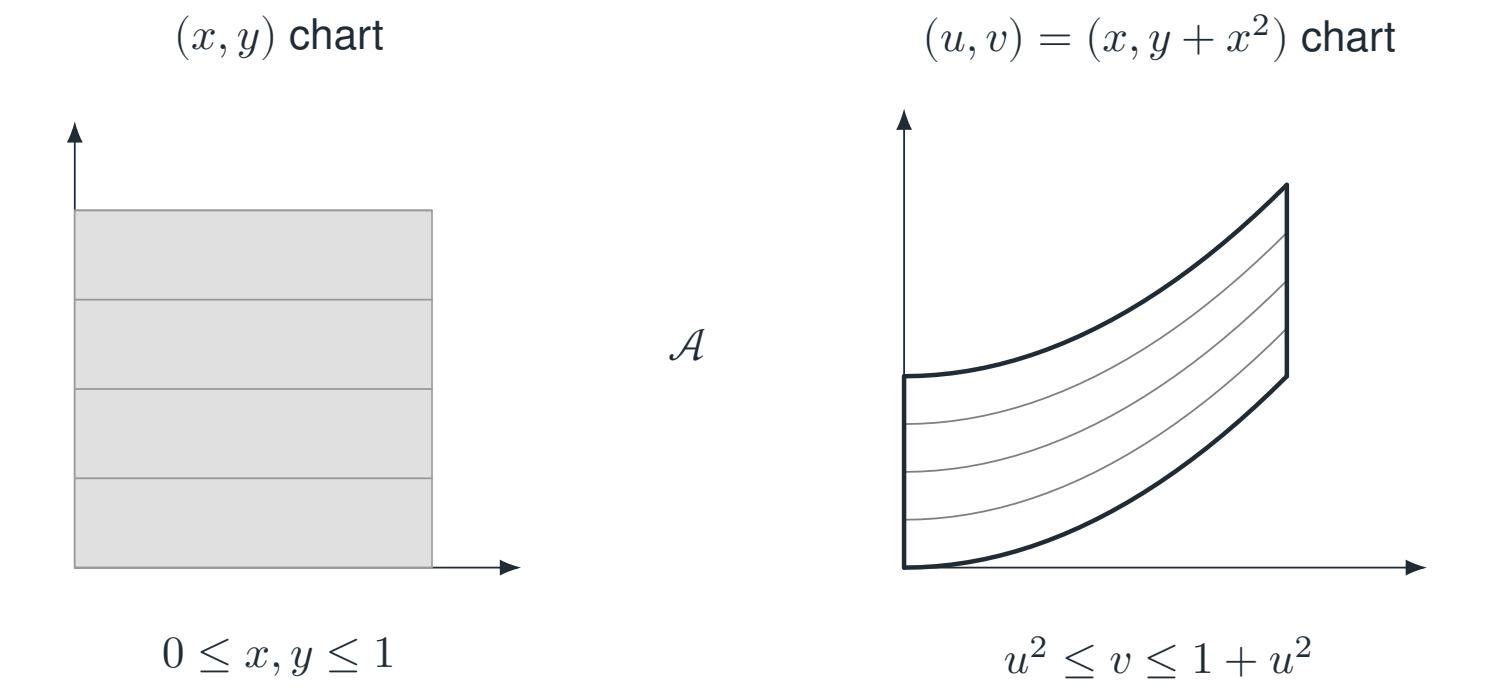
Reading the drawing
Horizontal segments become parabolic boundaries in the other chart. The exact inverse identities concern the polynomial formulas; the plotted samples only render the boundaries.
Drawing labels and data 5 labels
Read the original labels as selectable text. Tables preserve grid relationships; other short labels are grouped compactly.
- \((x,y)\) chart
- \((u,v)=(x,y+x^2)\) chart
- \(0\le x,y\le1\)
- \(u^2\le v\le1+u^2\)
\(\mathcal A\)
Evidence note from the source edition
Horizontal segments become parabolas, but no information is discarded. The drawing samples the displayed polynomial boundaries for rendering. Inverse identities and route equality are checked symbolically, not inferred from the curves.
Now represent the nonlinear operation \(F(x,y)=(x+y,xy)\) in the new chart. Set \(w=u+v-u^2\). Its correct coordinate formula is
For \((x,y)=(1,2)\), applying \(F\) first gives \((3,2)\) and then \((3,11)\) in the new chart. Changing the input first gives \((u,v)=(1,3)\), and \(\widehat F_b(1,3)=(3,11)\) as well.
The equality holds as a polynomial identity for all inputs. It is the naturality theorem for maps of sets: only the inverse laws for the coordinate maps are needed. No Taylor expansion, derivative, or higher chain rule is involved.
Read this as
Nonlinearity alone does not create a coordinate defect. Reusing the old formula after changing coordinates would be an extra modeling choice, not exact conjugation.