
The diagonal gauge on V14 commuted with each standard projector. Now use the gauge that mixes packets
The total obstruction transforms by conjugation, but its pattern in the fixed standard packets changes.
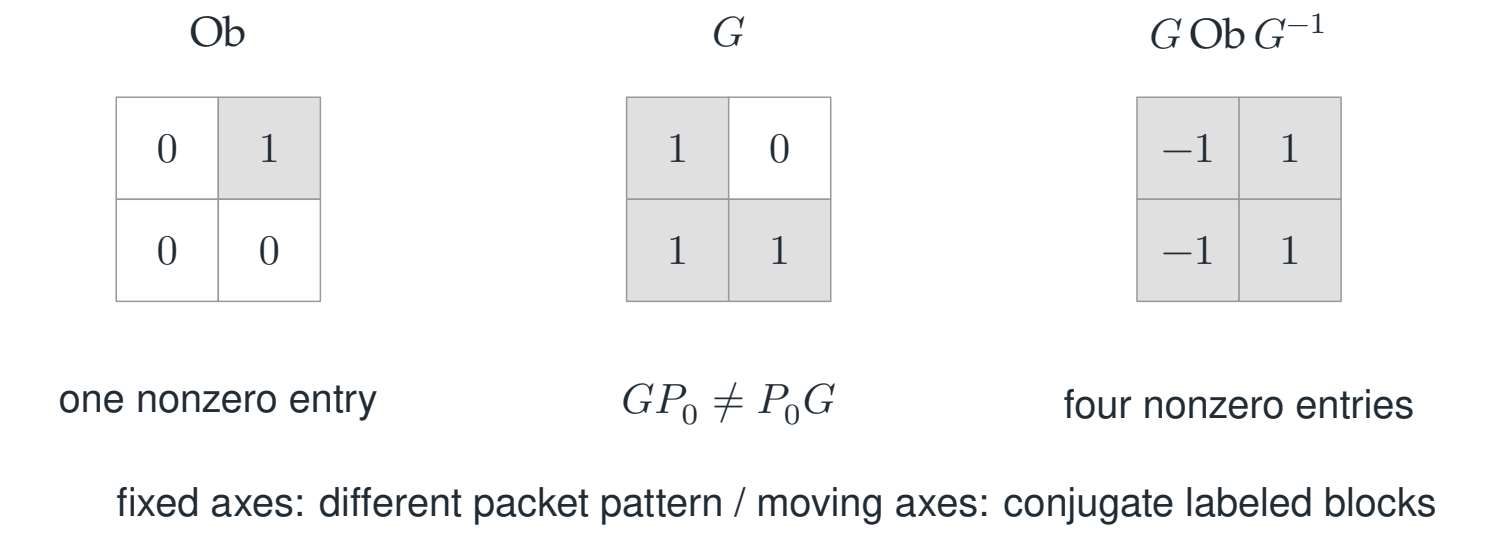
Reading the drawing
One nonzero entry becomes four nonzero entries in the fixed packet basis. Both obstruction matrices remain nonzero and have rank one.
Drawing labels and data 19 labels
Read the original labels as selectable text. Tables preserve grid relationships; other short labels are grouped compactly.
- \({\operatorname{Ob}}\)
| Row / column | Column 1 | Column 2 |
|---|---|---|
| Row 1 | \(0\) | \(1\) |
| Row 2 | \(0\) | \(0\) |
- \(G\)
| Row / column | Column 1 | Column 2 |
|---|---|---|
| Row 1 | \(1\) | \(0\) |
| Row 2 | \(1\) | \(1\) |
- \(G{\operatorname{Ob}} G^{-1}\)
| Row / column | Column 1 | Column 2 |
|---|---|---|
| Row 1 | \(-1\) | \(1\) |
| Row 2 | \(-1\) | \(1\) |
- one nonzero entry
- \(GP_0\ne P_0G\)
- four nonzero entries
fixed axes: different packet pattern / moving axes: conjugate labeled blocks
Evidence note from the source edition
The first obstruction has one nonzero entry. Its conjugate has four. Both have rank one and are nonzero. The change in fixed block pattern is not a change in whether the connection is flat.
Direct multiplication gives
For example, the original \((0,0)\) block vanishes, while the new \((0,0)\) block relative to the old coordinate projectors does not. This is why the theorem about preservation of each block's zero status requires \(G P_i=P_iG\).
Transporting the packet frame as well
Define \(Q_i=GP_iG^{-1}\). Then the identities cancel exactly:
Relative to these transported packets, the corresponding labeled blocks again have matching vanishing status. These are the same oblique projectors displayed on V17. One must distinguish moving the operator alone in a fixed resolution from moving the entire resolved description.
Read this as
The total obstruction is intrinsic under gauge. Its location in a fixed packet grid is not, unless the gauge preserves that grid.