
Let \(F_a\) synthesize chart coordinates into one ambient \({\mathbb Q}^2\). Choose
The same ambient vector \(x=(3,2)^\mathsf T\) has chart coordinates \(u_a=F_a^{-1}x\).
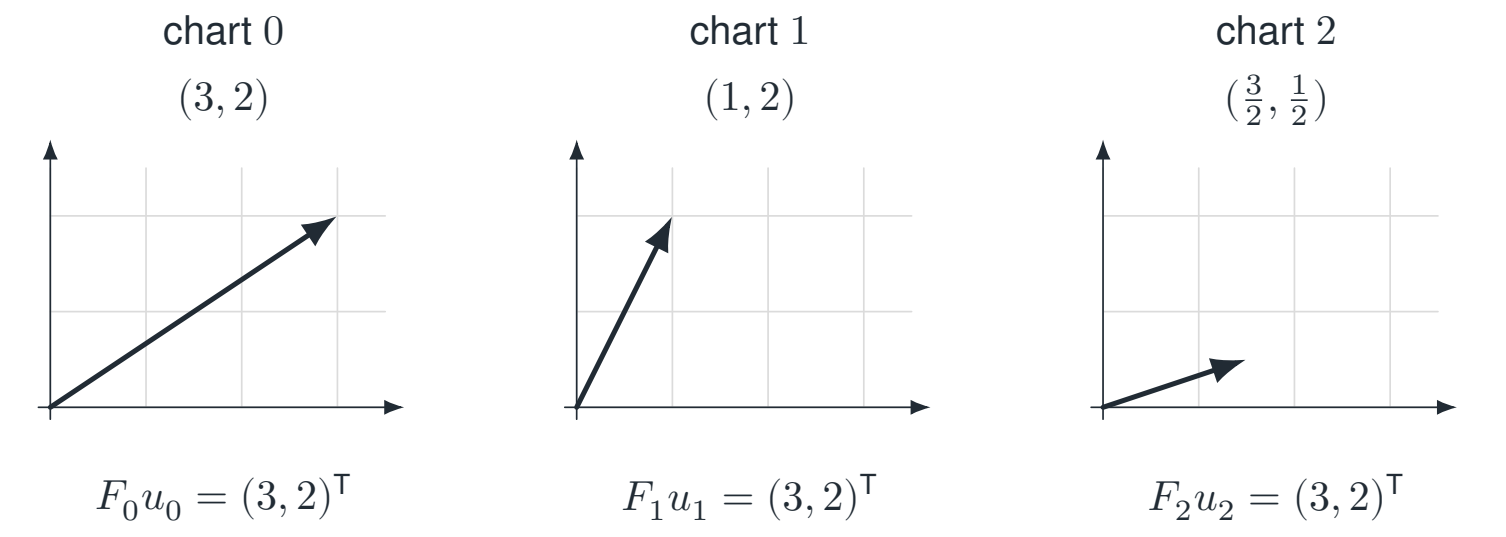
Reading the drawing
Each panel uses a different coordinate basis. Applying the corresponding synthesis frame to any displayed coordinate vector recovers the same ambient vector.
Drawing labels and data 9 labels
Read the original labels as selectable text. Tables preserve grid relationships; other short labels are grouped compactly.
- chart \(0\)
- \((3,2)\)
\(F_0u_0=(3,2)^\mathsf T\)
- chart \(1\)
- \((1,2)\)
\(F_1u_1=(3,2)^\mathsf T\)
- chart \(2\)
\((\frac{3}{2},\frac{1}{2})\)
\(F_2u_2=(3,2)^\mathsf T\)
Evidence note from the source edition
Each panel is a coordinate plane, not a different physical location. The numerical arrows differ because the frames differ. Multiplying each coordinate vector by its corresponding \(F_a\) recovers the same \(x\).
Transport from chart \(a\) to chart \(b\) is forced:
The route \(0\to1\to2\) agrees with the direct route because the middle frame cancels:
Returning to chart \(0\) cancels every remaining frame. The final coordinate vector is \((3,2)^\mathsf T\), not a sheared or rotated variant.
No metric is required
The frames need not be orthogonal. The second one is a shear, and the third has determinant two. Exact invertibility, rather than preservation of angles or lengths, gives the cocycle and loop identities. The same telescoping argument works for every finite chart path.
Read this as
A canonical coordinate loop is a sequence of changes in description of one object. Nonidentity holonomy requires additional transport data, not merely nonorthogonal charts.