
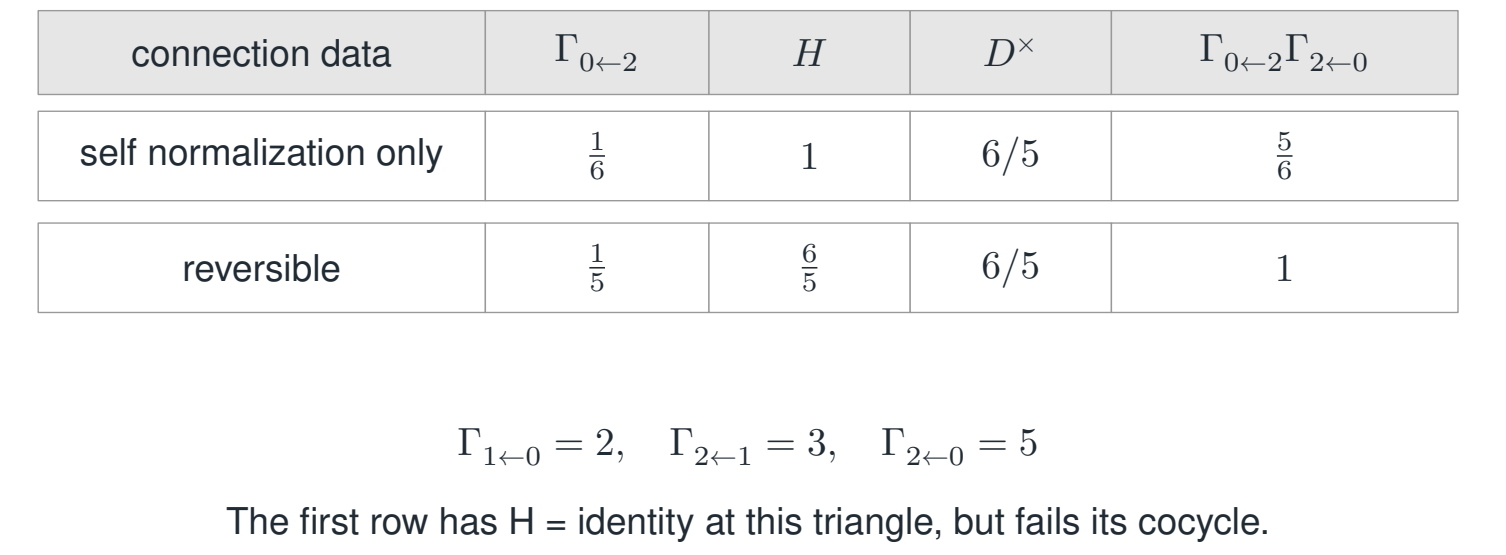
Choose the forward scalar transports \(\Gamma_{1\leftarrow0}=2\), \(\Gamma_{2\leftarrow1}=3\), and \(\Gamma_{2\leftarrow0}=5\). Their multiplicative comparison between transport through two steps and direct transport is \(D^\times=6/5\). A loop also needs a declared return map \(\Gamma_{0\leftarrow2}\).
Reading the drawing
The two rows compare arbitrary invertible scalar transport with reverse transport chosen as the forward inverse. The first row illustrates why invertibility alone does not impose reversibility.
Drawing labels and data 17 labels
Read the original labels as selectable text. Tables preserve grid relationships; other short labels are grouped compactly.
- connection data
- \(\Gamma_{0\leftarrow2}\)
- \(H\)
- \(D^\times\)
- \(\Gamma_{0\leftarrow2}\Gamma_{2\leftarrow0}\)
- self normalization only
\(\frac{1}{6}\)
| Row / column | Column 1 | Column 2 |
|---|---|---|
| Row 1 | \(1\) | \(6/5\) |
| Row 2 | \(\frac{6}{5}\) | \(6/5\) |
\(\frac{5}{6}\)
- reversible
\(\frac{1}{5}\)
- \(1\)
The first row has H = identity at this triangle, but fails its cocycle.
Evidence note from the source edition
All transports are invertible rational scalars and transport from each chart to itself is one. The first row is permitted by the minimal interface. The second uses the inverse of the direct forward edge and therefore satisfies that part of reversibility.
In the first row, choose the return scalar \(1/6\). Then
This triangle loop is the identity even though its cocycle equation fails. The return is not the inverse of the direct transport: \((1/6)5\ne1\). Thus one cannot transfer the reversible equivalence between defect and holonomy to the minimal interface.
In the reversible row, the return is \(1/5\). Now the loop is \(6/5\), and the additive defect of one is converted into the loop obstruction \(1/5\) by that inverse return map.
Two safeguards
Global flatness in the minimal interface implies trivial loops by using its cocycle on the whole route, including the return. Separately, in the reversible interface, triviality of each triangle loop is equivalent to that triangle's cocycle. Neither assertion says that one isolated loop certifies all triangles.
Read this as
Self normalization means \(\Gamma_{a\leftarrow a}=I\). Reversible additionally means \(\Gamma_{a\leftarrow b}=\Gamma_{b\leftarrow a}^{-1}\). These are different assumptions.