
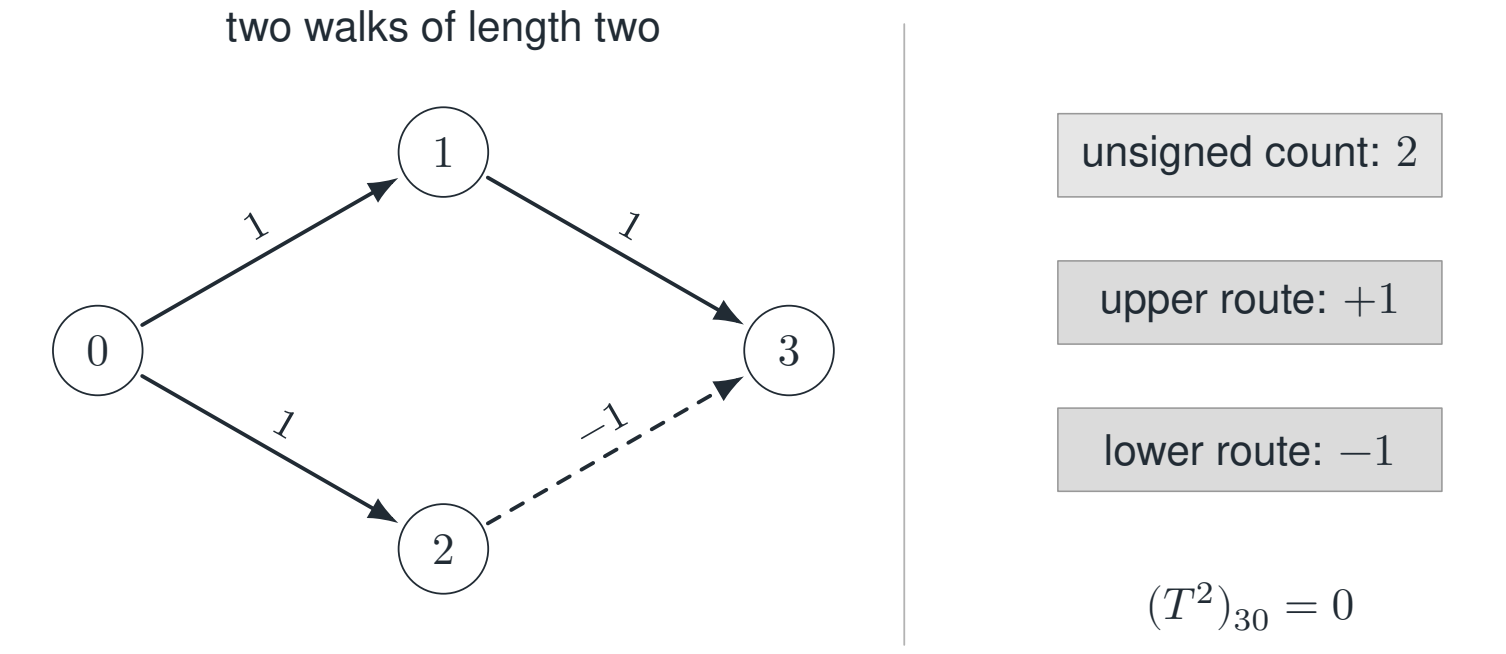
Consider a diamond: two routes of length two from packet \(0\) to packet \(3\). Three edge coefficients are \(1\) and the lower final coefficient is \(-1\). Both routes are correctly typed. Neither is annihilated by an interface mismatch.
Reading the drawing
The dashed edge carries a negative coefficient. Both paths are present, but their signed transfer contributions sum to zero while the unsigned path count is two.
Drawing labels and data 13 labels
Read the original labels as selectable text. Tables preserve grid relationships; other short labels are grouped compactly.
- \(0\)
- \(1\)
- \(2\)
- \(3\)
- \(1\)
- \(1\)
- \(1\)
- \(-1\)
- two walks of length two
- unsigned count: \(2\)
- upper route: \(+1\)
- lower route: \(-1\)
- \((T^2)_{30}=0\)
Evidence note from the source edition
The dashed edge carries the coefficient \(-1\). It is an actual edge, not an uncertain or missing one. Both paths exist. The unsigned count is two, while their exact operator contributions sum to zero.
The endpoint identity gives
Thus the paper's reachability implication has a definite direction:
Its converse is false. A zero entry may come from absent paths, zero coefficients, zero divisors in the coefficient ring, or cancellation among nonzero terms. The diamond exhibits the last possibility over \({\mathbb Z}\), where no zero divisor is needed.
Three different support records
The declared graph records permitted routes. The support of an individual word records the endpoints of that word when its coefficient is nonzero. The support of the sum records what remains after all contributions have been added. Passing from either of the first two records to the last requires the coefficients, not just adjacency.
A deliberately false test in the companion script asserts that reachability forces nonzero transfer. This diamond makes the test fail. That is a check against overreading the theorem, not a defect in the theorem.
Read this as
Do not interpret a visible route as an occupied output. Graph support is a useful upper bound. Signed operator support can be strictly smaller.