
Use three coordinate packets with projectors \(P_0,P_1,P_2\), and set
Here \(H\) is invertible, so it can be the loop product of a reversible connection on three charts. Its entries outside the diagonal encode two effects that mix packets.
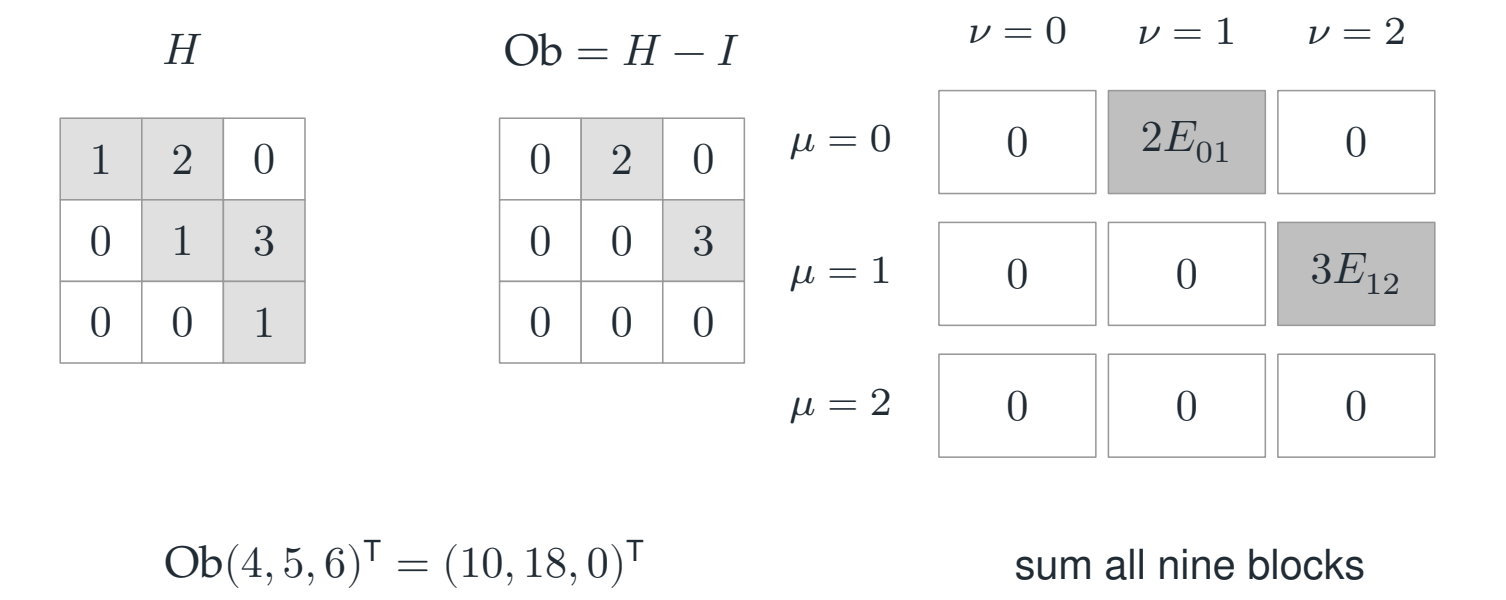
Reading the drawing
The board retains all nine embedded blocks. Its rows are output packets and columns are input packets; two off-diagonal addresses carry the nonzero maps.
Drawing labels and data 37 labels
Read the original labels as selectable text. Tables preserve grid relationships; other short labels are grouped compactly.
- \(H\)
| Row / column | Column 1 | Column 2 | Column 3 |
|---|---|---|---|
| Row 1 | \(1\) | \(2\) | \(0\) |
| Row 2 | \(0\) | \(1\) | \(3\) |
| Row 3 | \(0\) | \(0\) | \(1\) |
- \({\operatorname{Ob}}=H-I\)
| Row / column | Column 1 | Column 2 | Column 3 |
|---|---|---|---|
| Row 1 | \(0\) | \(2\) | \(0\) |
| Row 2 | \(0\) | \(0\) | \(3\) |
| Row 3 | \(0\) | \(0\) | \(0\) |
| Row / column | \(\nu=0\) | \(\nu=1\) | \(\nu=2\) |
|---|---|---|---|
| \(\mu=0\) | \(0\) | \(2E_{01}\) | \(0\) |
| \(\mu=1\) | \(0\) | \(0\) | \(3E_{12}\) |
| \(\mu=2\) | \(0\) | \(0\) | \(0\) |
\({\operatorname{Ob}}(4,5,6)^\mathsf T=(10,18,0)^\mathsf T\)
- sum all nine blocks
Evidence note from the source edition
The board on the right contains all nine actual embedded blocks \(P_\mu{\operatorname{Ob}} P_\nu\). Row labels are output packets and column labels are input packets. Only the addresses \((0,1)\) and \((1,2)\) carry nonzero maps.
Completeness on both sides supplies the reconstruction:
For \(x=(4,5,6)^\mathsf T\), the input in packet \(1\) contributes \(10e_0\) and the input in packet \(2\) contributes \(18e_1\). Their sum is the full displacement \({\operatorname{Ob}} x\).
A block becomes a witness when it acts
The nonzero block \(2E_{01}\) has the explicit source vector \(e_1\), supported entirely in packet \(1\), and \(P_0{\operatorname{Ob}} e_1=2e_0\ne0\). Similarly, \(P_1{\operatorname{Ob}} e_2=3e_1\ne0\). The general theorem supplies such a witness classically when a nonzero block is known. The example displays it concretely.
Read this as
An obstruction packet is not just a colored matrix cell. It consists of a specific label for a pair of packets and an exact nonvanishing statement about the corresponding map.