
E6 Conditional expectation and martingale packets
On this page · Permalink · Source line 3009
Let \(\Omega=\{1,\ldots,n\}\) have strictly positive probabilities \(\pi_i\). For a partition \(\mathcal Q\), let \(B(i)\) denote the block containing \(i\). Define
Equip \({\mathbb C}^n\) with
Theorem E6.1: Finite conditional expectation
The operator \(P_\mathcal Q\) is the orthogonal projector onto the functions that are constant on every block of \(\mathcal Q\). In particular,
Read proof · Read statement and proof side by side · Permalink · Source line 3025 · Claim record · Lean coverage · Code · Worked examples
Proof of Theorem E6.1
One application produces a block constant function, so a second application changes nothing. Expanding both weighted inner products block by block gives
The range is exactly the block constant subspace.
Back to statement · Read statement and proof side by side · Permalink · Source line 3034 · Claim record · Lean coverage · Code · Worked examples
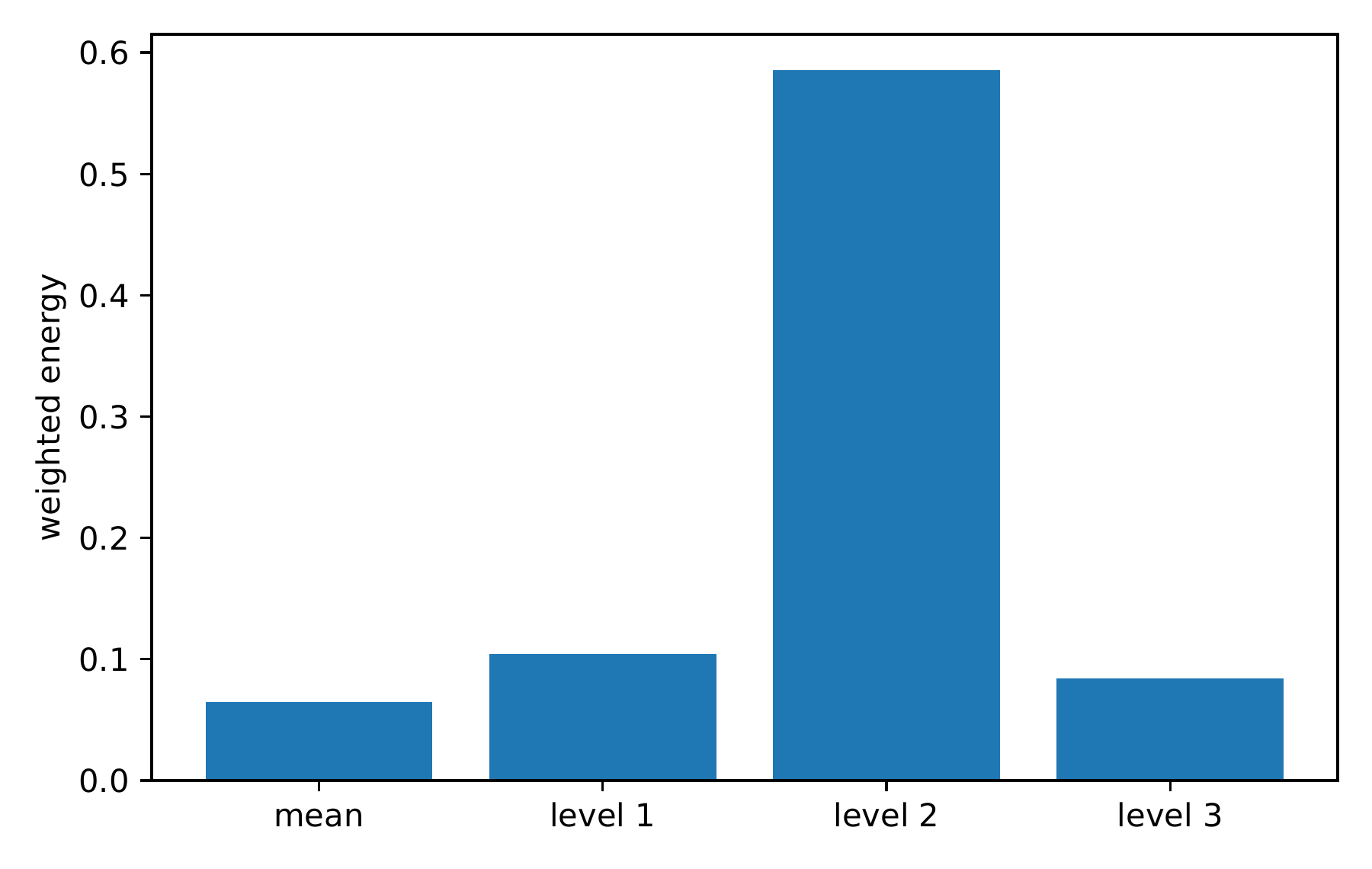
Theorem E6.2: Tower law and martingale packets
Let \(P_0,P_1,\ldots,P_r\) come from increasingly fine partitions, so that
Define
Then
Every \(D_j\) is an orthogonal projector, and
and
Read proof · Read statement and proof side by side · Permalink · Source line 3050 · Claim record · Lean coverage · Code · Worked examples
Proof of Theorem E6.2
A coarse average of a fine average is the coarse average. A fine average leaves a coarse constant function unchanged. Hence \(P_iP_j=P_{\min(i,j)}\). Expanding products of the differences gives the orthogonality relations. The sum telescopes to \(P_r\). Orthogonal Pythagorean identities give the norm formulas.
Back to statement · Read statement and proof side by side · Permalink · Source line 3086 · Claim record · Lean coverage · Code · Worked examples
Corollary E6.3: Law of total variance
For a real valued \(f\), let \(P_0f={\mathbb E}_\pi[f]{{\boldsymbol{1}}}\). Then
Read proof · Read statement and proof side by side · Permalink · Source line 3090 · Claim record · Lean coverage · Code · Worked examples
Proof of Corollary E6.3
Subtract the mean and apply the orthogonal decomposition into the range of \(P_\mathcal Q\) and its orthogonal complement.
Back to statement · Read statement and proof side by side · Permalink · Source line 3101 · Claim record · Lean coverage · Code · Worked examples
Standard fact E6.4: General conditional expectations
On a probability space, conditional expectation onto a sub sigma algebra is the orthogonal projector in \(L^2\). Nested sigma algebras satisfy the same tower law. Under the usual hypotheses, martingale convergence gives a limit in \(L^2\) and almost surely. Standard treatments include [Williams1991].
Permalink · Source line 3112 · Claim record · Lean coverage · Code · Worked examples