
E11 Fractional functional calculus
On this page · Permalink · Source line 3916
Let \(H\) be a finite dimensional Hilbert space and let \(L=L^*\geq0\). Write its spectral resolution as
For \(\alpha>0\), define
and
Theorem E11.1: Fractional packet calculus
For \(\alpha,\beta>0\),
For \(s,t\geq0\),
Every spectral packet \(P_jH\) reduces \(L^\alpha\) and \(T_\alpha(t)\).
Read proof · Read statement and proof side by side · Permalink · Source line 3937 · Claim record · Lean coverage · Code · Worked examples
Proof of Theorem E11.1
The claims hold on each spectral packet and the projectors are mutually orthogonal.
Back to statement · Read statement and proof side by side · Permalink · Source line 3949 · Claim record · Lean coverage · Code · Worked examples
Theorem E11.2: Balakrishnan formula in finite dimension
For \(0<\alpha<1\),
The integral converges in operator norm.
Read proof · Read statement and proof side by side · Permalink · Source line 3953 · Claim record · Lean coverage · Code · Worked examples
Proof of Theorem E11.2
It is enough to prove the formula on an eigenvector with eigenvalue \(x\geq0\). For \(x>0\), the substitution \(s=xu\) gives
The value at \(x=0\) is zero. There are finitely many eigenvalues, so the operator integral converges. This is the finite spectral form of the fractional power construction in [Balakrishnan1960].
Back to statement · Read statement and proof side by side · Permalink · Source line 3966 · Claim record · Lean coverage · Code · Worked examples
Theorem E11.3: Exact fractional naturality
Let \(L_f\) and \(L_c\) be finite dimensional positive self adjoint operators and let \(C\) satisfy
Then, for every \(\alpha>0\) and \(t\geq0\),
and
Read proof · Read statement and proof side by side · Permalink · Source line 3980 · Claim record · Lean coverage · Code · Worked examples
Proof of Theorem E11.3
The union of the two finite spectra is a finite set. There is a polynomial that agrees with \(x^\alpha\) on that set, and another polynomial that agrees with \({\mathrm e}^{-tx^\alpha}\). Exact intertwining passes to every polynomial by induction.
Back to statement · Read statement and proof side by side · Permalink · Source line 3997 · Claim record · Lean coverage · Code · Worked examples
Theorem E11.4: Fractional defect bound
Let \(0<\alpha<1\). Suppose
for some \(m>0\). Define
Then
Consequently,
Read proof · Read statement and proof side by side · Permalink · Source line 4001 · Claim record · Lean coverage · Code · Worked examples
Proof of Theorem E11.4
Set
The resolvent identity gives
Since \(LR=I-sR\),
Insert this into Theorem E11.2. The spectral lower bound gives
Therefore
The semigroup estimate follows from Theorem E3.1, applied to the contraction generators \(-L_f^\alpha\) and \(-L_c^\alpha\).
Back to statement · Read statement and proof side by side · Permalink · Source line 4030 · Claim record · Lean coverage · Code · Worked examples
Remark E11.5
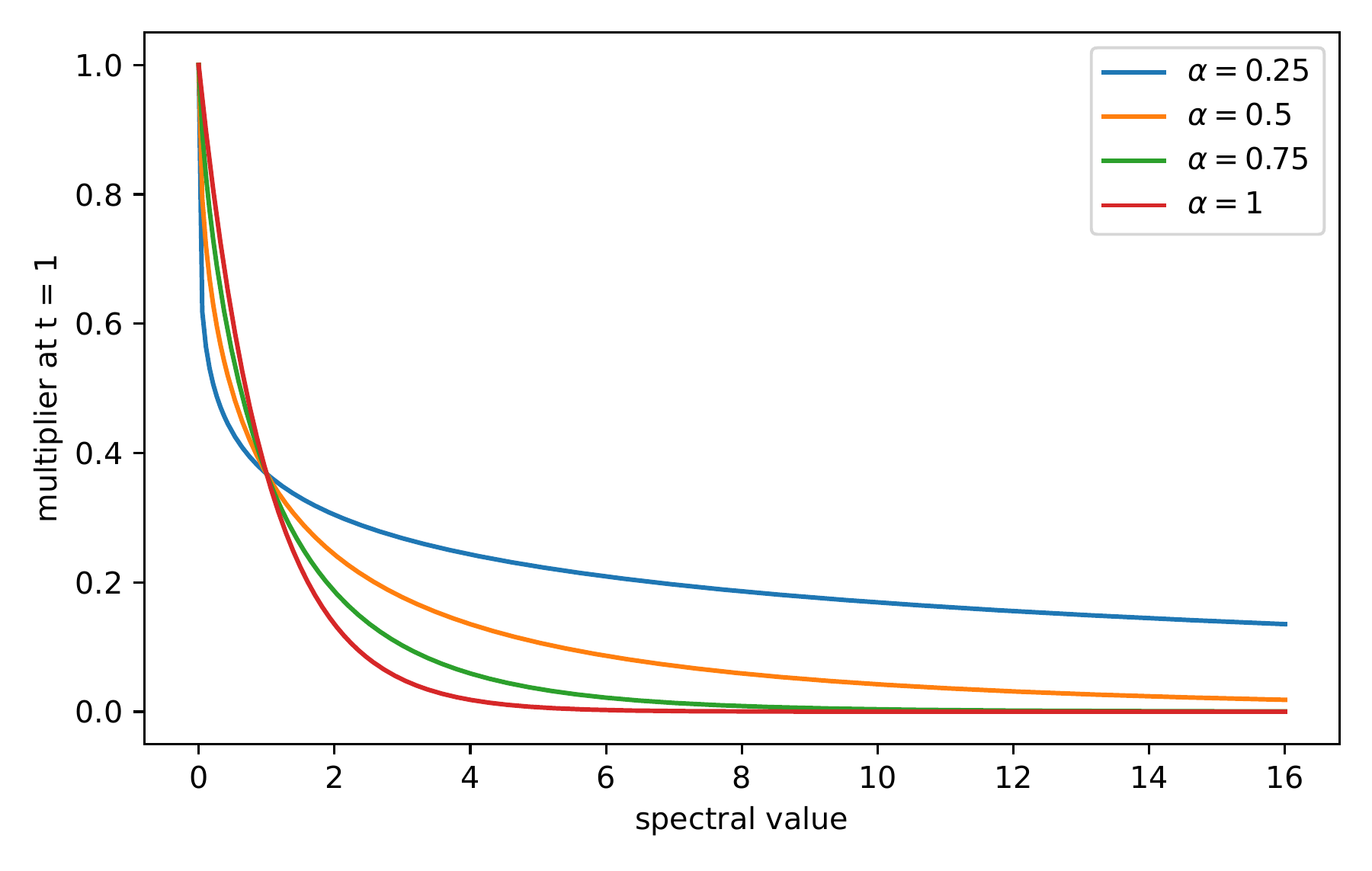
The factor \(m^{\alpha-1}\) records the singular behavior of \(x^\alpha\) near zero. Without a common positive lower bound, a uniform Lipschitz estimate of this form cannot be expected.
Standard fact E11.6: Stable subordination
Let \(0<\alpha<1\) and \(t>0\). There is a probability measure \(\eta_{\alpha,t}\) on \([0,\infty)\) such that
for every \(\lambda\geq0\). Consequently, for a finite dimensional positive self adjoint operator,
in operator norm. The measures satisfy the convolution law
Permalink · Source line 4075 · Claim record · Lean coverage · Code · Worked examples
The existence of \(\eta_{\alpha,t}\) follows from complete monotonicity of \({\mathrm e}^{-t\lambda^\alpha}\). The operator identity is obtained by applying the scalar Laplace transform on every spectral packet. This is the finite spectral form of Bochner subordination. See [SchillingSongVondracek2012].
Theorem E11.7: Poisson subordination
For \(t>0\),
The integral converges in operator norm.
Read proof · Read statement and proof side by side · Permalink · Source line 4099 · Claim record · Lean coverage · Code · Worked examples
Proof of Theorem E11.7
On a spectral packet with eigenvalue \(\lambda\), the formula reduces to
This scalar identity follows from the Gaussian integral. Recombine the finitely many spectral packets.
Back to statement · Read statement and proof side by side · Permalink · Source line 4114 · Claim record · Lean coverage · Code · Worked examples
Remark E11.8
For sectorial and nonnormal operators, fractional powers require a resolvent or contour calculus together with domain control. The finite self adjoint theory proved here does not remove those analytic requirements. A broader account appears in [SchillingSongVondracek2012].