
E16 Survival, moments, and competing risks
On this page · Permalink · Source line 4899
Let \(A\) be a transient state subgenerator. Its off diagonal entries are nonnegative and its column sums are nonpositive. Let \(p_0\) be a transient probability vector. Define
The row vector \(a^T\) contains the exit rates.
Theorem E16.1: State dependent killing as survival
Let \(Q\) be a finite Markov generator, let \(V\geq0\), and set
For an initial distribution \(p_0\), define
Then
Also,
The matrix \(A=Q-D_V\) has nonnegative off diagonal entries and nonpositive column sums, so it is the subgenerator of the killed, possibly nontransient chain. Thus the potential in the finite Feynman Kac formula is a state dependent killing rate in the forward sub-Markov semigroup. Almost-sure absorption follows under the additional spectral stability hypothesis used below.
Read proof · Read statement and proof side by side · Permalink · Source line 4911 · Claim record · Lean coverage · Code · Worked examples
Proof of Theorem E16.1
Average Theorem E13.2 with terminal function \(f={{\boldsymbol{1}}}\) against the initial distribution. Transposition gives
Since \({{\boldsymbol{1}}}^TQ=0\), differentiation gives
Back to statement · Read statement and proof side by side · Permalink · Source line 4940 · Claim record · Lean coverage · Code · Worked examples
Theorem E16.2: Survival and hazard identities
The event density and hazard are
whenever \(S(t)>0\). The survival function is nonincreasing and
Read proof · Read statement and proof side by side · Permalink · Source line 4955 · Claim record · Lean coverage · Code · Worked examples
Proof of Theorem E16.2
Because \(A\) is a Metzler matrix, \({\mathrm e}^{tA}\) is nonnegative. The column sum assumption makes \(a^T\) nonnegative. Differentiate \(S(t)\):
The remaining identity follows by integrating \((\log S)'=-h\).
Back to statement · Read statement and proof side by side · Permalink · Source line 4972 · Claim record · Lean coverage · Code · Worked examples
Theorem E16.3: Laplace transform and moments
Assume the spectrum of \(A\) lies in the open left half plane. Then absorption occurs with probability one. For \(s\geq0\),
For every integer \(m\geq1\),
Read proof · Read statement and proof side by side · Permalink · Source line 4980 · Claim record · Lean coverage · Code · Worked examples
Proof of Theorem E16.3
The Laplace transform follows by integrating the density in Theorem E16.2. Stability of \(A\) gives
At \(s=0\),
For the moments,
Multiplying by \(a^T={{\boldsymbol{1}}}^T(-A)\) gives the result. These are the standard matrix formulas for phase type laws [Neuts1981], [AsmussenNermanOlsson1996].
Back to statement · Read statement and proof side by side · Permalink · Source line 4994 · Claim record · Lean coverage · Code · Worked examples
Proposition E16.4: Residual life as a restarted semigroup
For \(S(t)>0\), define the conditional transient distribution
Then
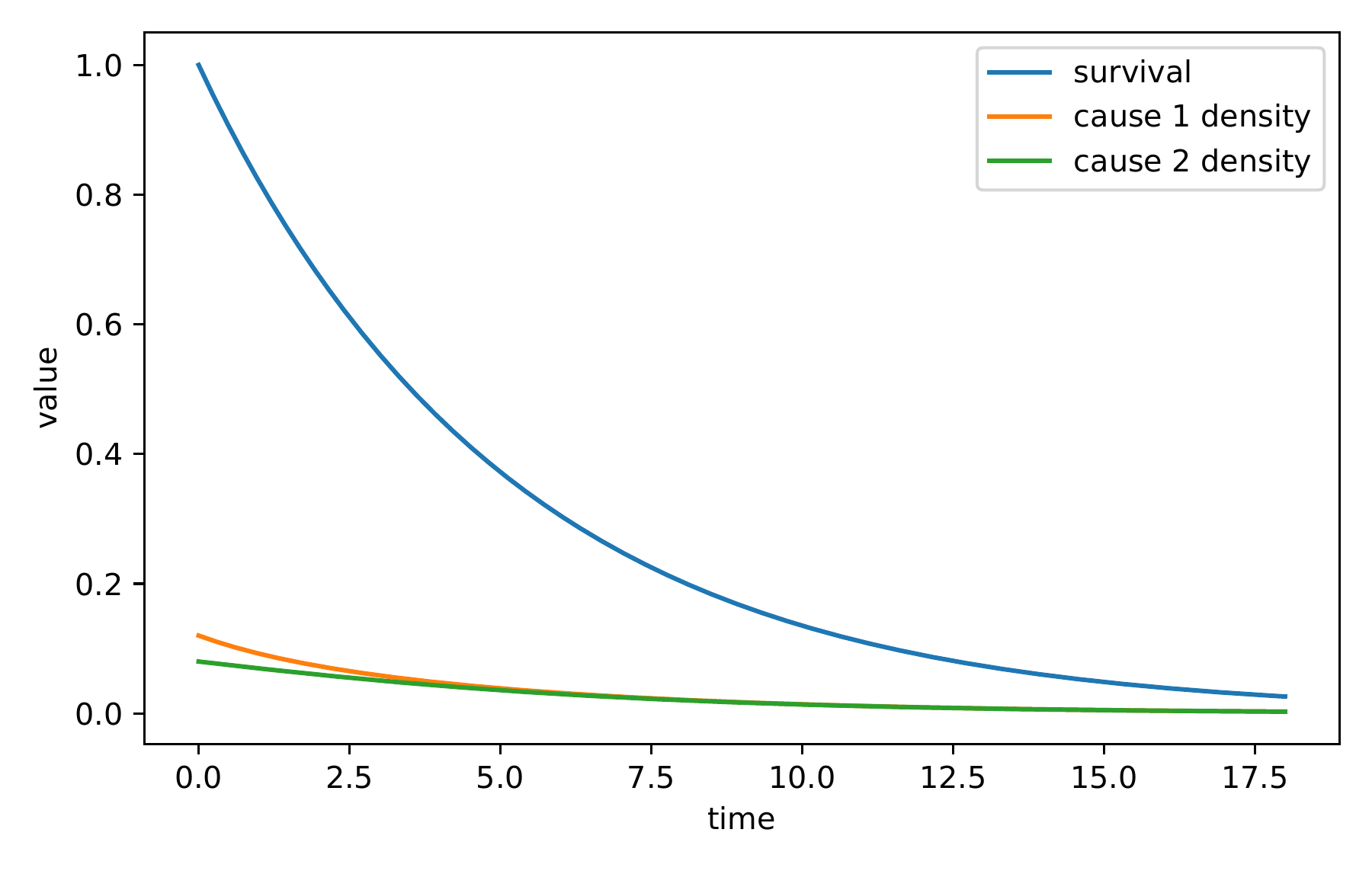
Read proof · Visual guide: Survivors have a different mixture of causes · Read statement and proof side by side · Permalink · Source line 5017 · Claim record · Lean coverage · Code · Worked examples
Proof of Proposition E16.4
Use the semigroup law in the numerator \(S(t+s)={{\boldsymbol{1}}}^T{\mathrm e}^{sA}{\mathrm e}^{tA}p_0\).
Back to statement · Read statement and proof side by side · Permalink · Source line 5032 · Claim record · Lean coverage · Code · Worked examples
Theorem E16.5: Competing risk packets
Suppose the exit row splits into nonnegative cause rows
Define
Then
The cause specific hazard is
and
If the spectrum of \(A\) lies in the open left half-plane, the eventual probability of cause \(r\) is
Read proof · Visual guide: Survivors have a different mixture of causes · Read statement and proof side by side · Permalink · Source line 5036 · Claim record · Lean coverage · Code · Worked examples
Proof of Theorem E16.5
Every identity follows by linearity and the stable resolvent integral.
Back to statement · Read statement and proof side by side · Permalink · Source line 5067 · Claim record · Lean coverage · Code · Worked examples
Remark E16.6
A finite phase type hazard need not be monotone. The semigroup formulas guarantee nonnegative density and decreasing survival, not monotonicity of the hazard.