
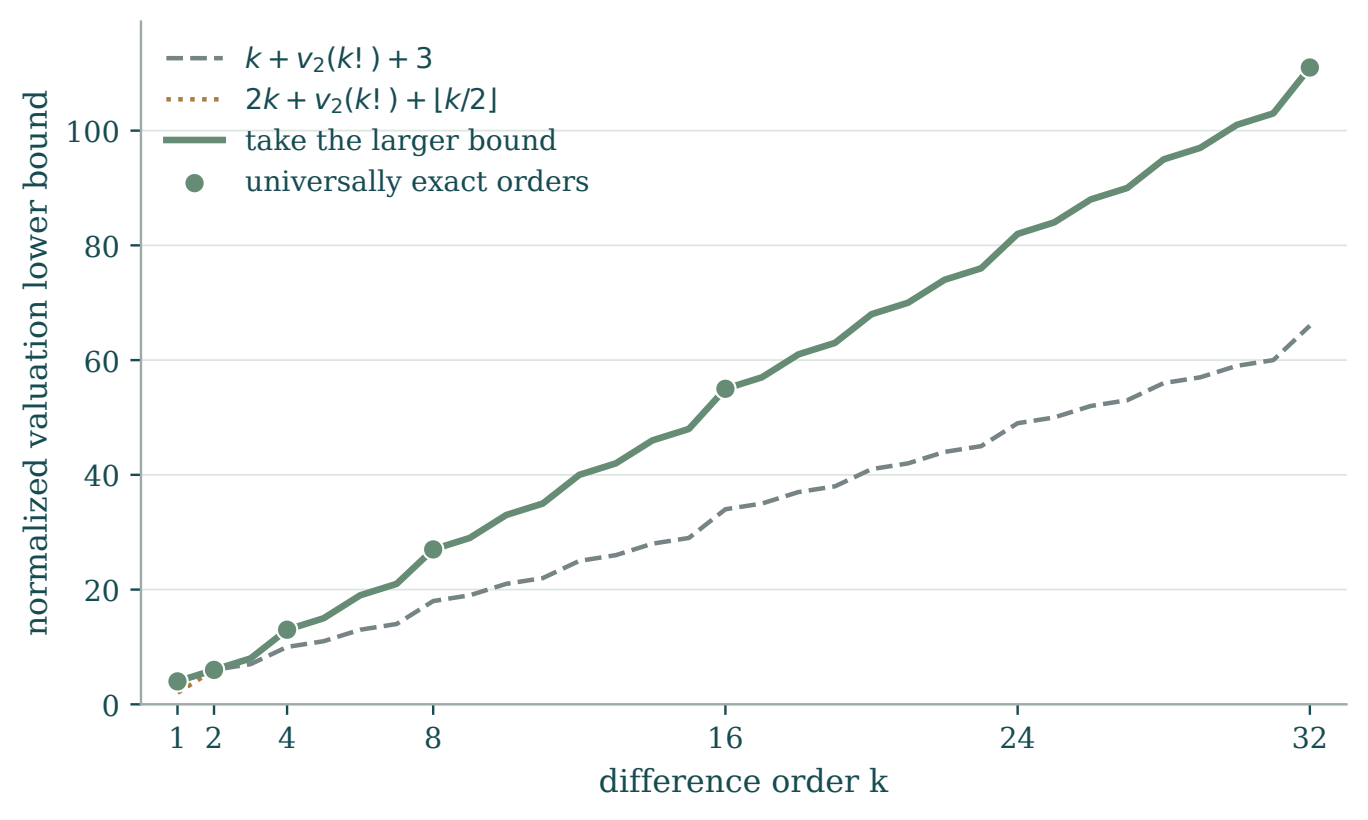
The normalized address-two sequence obeys both
Their maximum supplies the useful envelope.
Reading the figure
The dashed curve is the constant-surplus bound. The dotted curve adds the paired-filtration gain. The solid curve takes their maximum. Powers of two mark the universally exact orders. These are normalized coefficients; the original Euler normalization adds one to the displayed bounds.
Mathematical labels
\(k+v_2(k!)+3\)
\(2k+v_2(k!)+\lfloor k/2\rfloor\)
Selectable labels from the original PDF
Native PDF text retains the figure’s extraction order. Equations and data tables above provide the reading order.
1
2
4
8 16 24 32
difference order k
0
20
40
60
80
100
normalized valuation lower bound
k
+
v
2
(
k! )
+
3
2
k
+
v
2
(
k! )
+
⌊
k/
2
⌋
take the larger bound
universally exact orders
Original figure caption
Normalized address-two precision. The paired filtration controls the large-order slope. At order one the constant-surplus bound is stronger.
For every base row and every positive step list, equality is proved when \(k\) is a power of two:
with \(V_2(1)=4\), \(V_2(2)=6\), and \(V_2(k)=2k+v_2(k!)+k/2\) for \(k=2^r\ge4\). The infinite marked family establishes sharpness at unbounded orders.
For original Euler coefficients add one, since \(v_2(2!)=1\). The extra \(\lfloor k/2\rfloor\) comes from a paired divided-power filtration in the Bernoulli transformation. It does not arise by fitting the plotted points.