
At precision \(2^r\) the least positive row period is
The exact valuation law proves both periodicity and minimality. A step \(H\) is a period precisely when \(v_2(H)+B_j\ge r\).
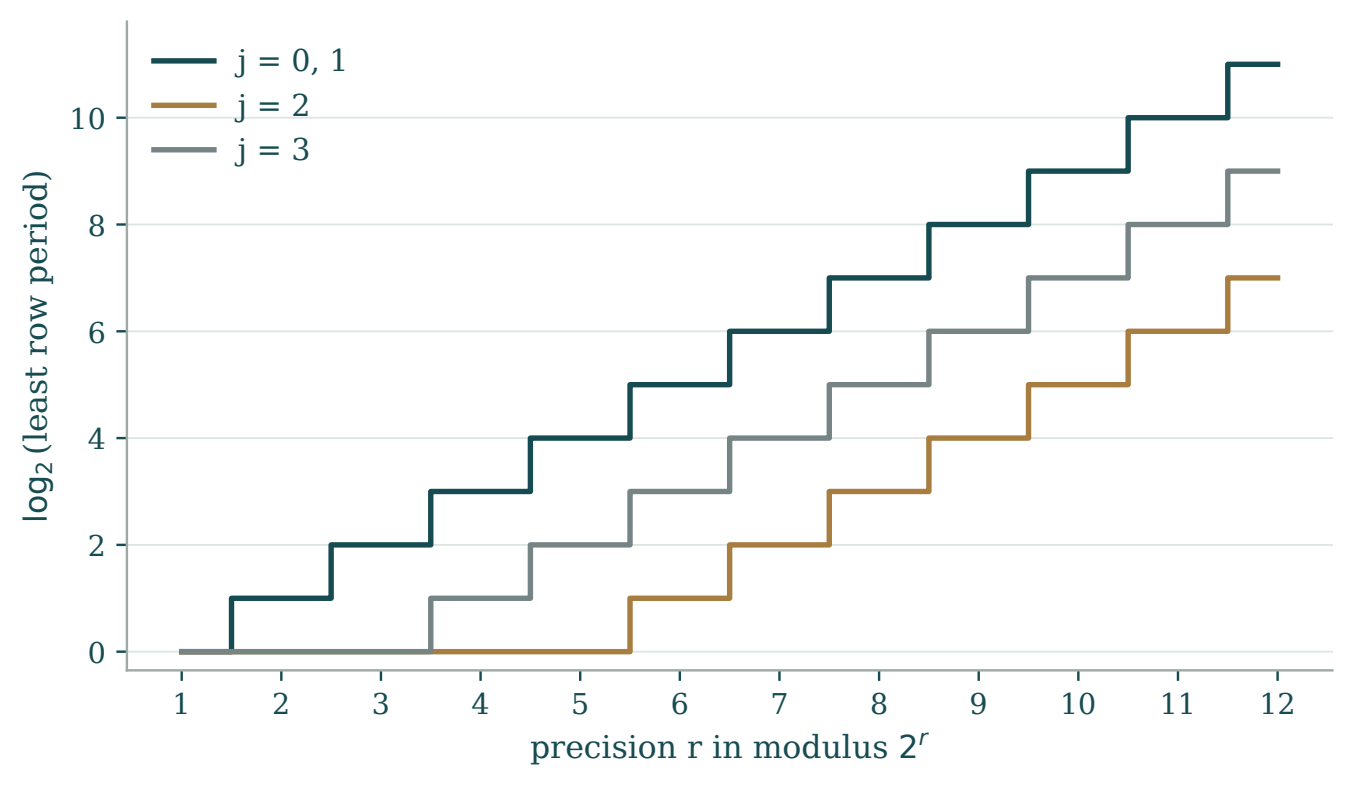
Reading the figure
For precision exponents one through twelve, each staircase is zero until precision exceeds its address scale and then rises by one per bit. Addresses zero and one share a staircase. Height zero means row period one, not period zero. Euler degree periods are four times the row periods.
Mathematical labels
precision r in modulus \(2^r\)
\(\log_2\)(least row period)
Selectable labels from the original PDF
Native PDF text retains the figure’s extraction order. Equations and data tables above provide the reading order.
1
2
3
4
5
6
7
8
9 10 11 12
p
r
e
c
i
s
i
o
n
r
i
n
m
o
d
u
l
u
s
2
r
02468
10
log2 (least row period)
j = 0, 1
j = 2
j = 3
Original figure caption
Binary logarithms of the least row periods. A height of zero means period one. These are theorem-derived values, valid at every precision.
Modulo \(256=2^8\), the least periods are
In actual Euler degree, multiply by four:
For address two, precision at most \(2^5\) already has row period one. Its Euler coefficients all lie in \(2+32\mathbb Z_2\); further precision resolves additional dyadic digits within that residue class.
The original rank-four conjectural shift has row step \(2^{r-1}\). It remains a valid period for every address, but addresses two and three usually admit shorter periods. The sharp theorem identifies the shortest one.