
For \(n\ge0\), \(k\ge1\), and \(H\ge1\), the actual Euler coefficients satisfy
where
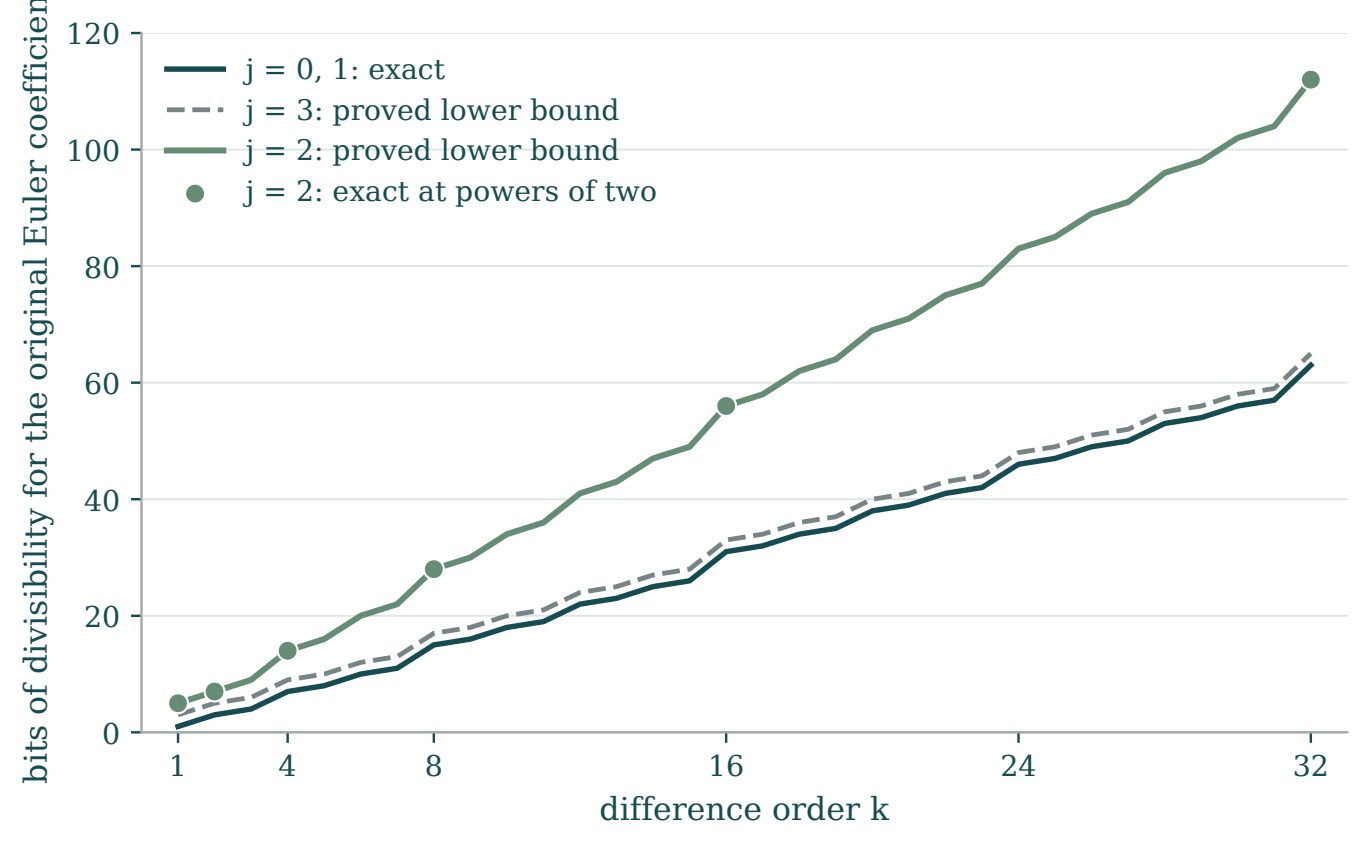
Reading the figure
The horizontal axis is difference order, one through thirty-two; height is bits of divisibility for the original Euler coefficients. Addresses zero and one share an exact curve. Address three has a proved lower bound. Address two has the larger lower bound, with exactness marked at powers of two. The table uses the recorded theorem-derived arrays.
| Order | Addresses 0 and 1 (exact) | Address 2 (lower bound) | Address 3 (lower bound) |
|---|---|---|---|
| 1 | 1 | 5 | 3 |
| 2 | 3 | 7 | 5 |
| 3 | 4 | 9 | 6 |
| 4 | 7 | 14 | 9 |
| 5 | 8 | 16 | 10 |
| 6 | 10 | 20 | 12 |
| 7 | 11 | 22 | 13 |
| 8 | 15 | 28 | 17 |
| 9 | 16 | 30 | 18 |
| 10 | 18 | 34 | 20 |
| 11 | 19 | 36 | 21 |
| 12 | 22 | 41 | 24 |
| 13 | 23 | 43 | 25 |
| 14 | 25 | 47 | 27 |
| 15 | 26 | 49 | 28 |
| 16 | 31 | 56 | 33 |
| 17 | 32 | 58 | 34 |
| 18 | 34 | 62 | 36 |
| 19 | 35 | 64 | 37 |
| 20 | 38 | 69 | 40 |
| 21 | 39 | 71 | 41 |
| 22 | 41 | 75 | 43 |
| 23 | 42 | 77 | 44 |
| 24 | 46 | 83 | 48 |
| 25 | 47 | 85 | 49 |
| 26 | 49 | 89 | 51 |
| 27 | 50 | 91 | 52 |
| 28 | 53 | 96 | 55 |
| 29 | 54 | 98 | 56 |
| 30 | 56 | 102 | 58 |
| 31 | 57 | 104 | 59 |
| 32 | 63 | 112 | 65 |
Selectable labels from the original PDF
Native PDF text retains the figure’s extraction order. Equations and data tables above provide the reading order.
1
4
8 16 24 32
difference order k
0
20
40
60
80
100
120
bits of divisibility for the original Euler coefficient
j = 0, 1: exact
j = 3: proved lower bound
j = 2: proved lower bound
j = 2: exact at powers of two
Original figure caption
The exponent of the final Euler congruence at unit step. The address zero and one curve is exact at every order. Marked address-two orders are universally exact; the other displayed address-two and address-three values are proved lower bounds.
At a common step with \(v_2(H)=s\), add \(ks\) to every displayed exponent. Thus a doubling of the step gains one additional bit per difference, rather than one bit for the whole expression.
This statement combines two different proved bounds at address two. A lower bound is not automatically an exact valuation: divisibility may be stronger at unmarked orders or at particular starting rows.