
The original Euler coefficient is \(E_{Nn}^{(N,j)}=j!C_{N,j}(n)\). Multiplication by \(j!\) changes the available \(p\)-adic precision. That change cannot be discarded outside the unit-factorial window.
Take \(p=3\), \(N=6\), \(j=3\), and compare rows one and two. Exact inversion gives
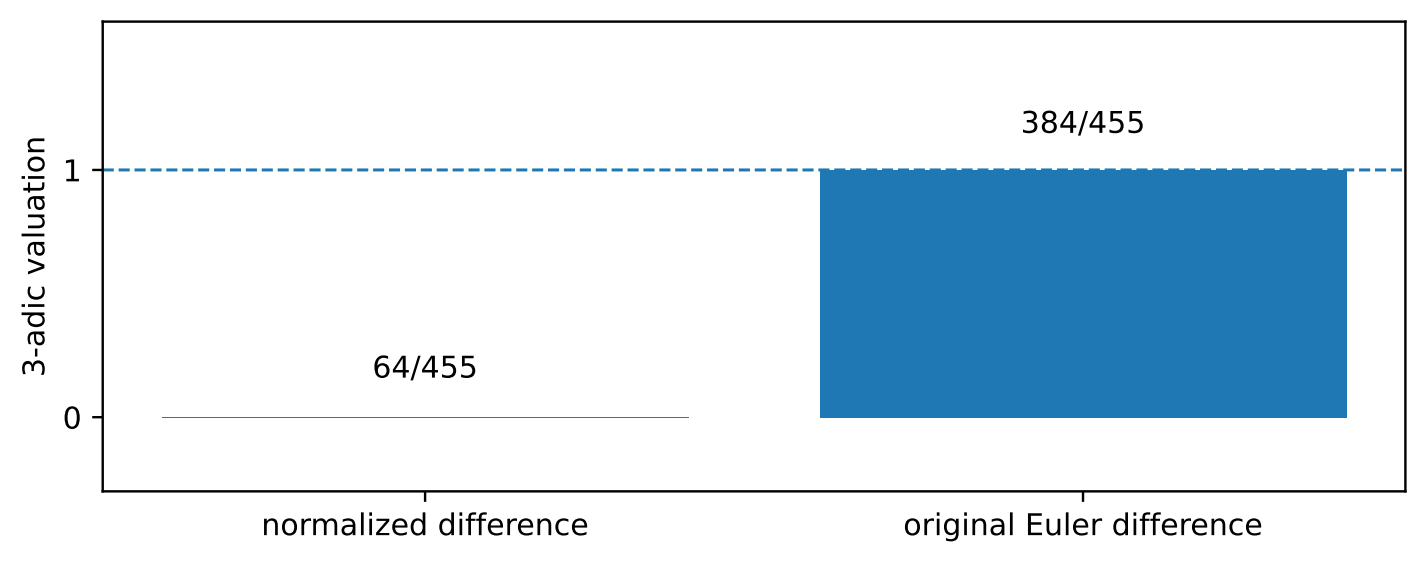
Reading the figure
The normalized difference has value 64/455 and valuation zero. Multiplication by the address factorial gives original Euler difference 384/455 and valuation one. The dashed level is one. This example concerns width six and address three.
| Quantity | Exact value |
|---|---|
| C1 | -1/84 |
| C2 | 703/5460 |
| difference | 64/455 |
| original_difference | 384/455 |
Selectable labels from the original PDF
Native PDF text retains the figure’s extraction order. Equations and data tables above provide the reading order.
normalized difference original Euler difference
01
3-adic valuation
64/455
384/455
Neither \(64\) nor \(455\) is divisible by three, so the normalized difference has valuation zero. The original coefficient difference is \(3!\cdot64/455=384/455\), of valuation one.
This is the counterexample behind the corrected factorial-loss statement. A bound for the original Euler normalization must lose \(v_p(j!)\) when translated to \(C_{N,j}\). For \(0\le j<p\), that loss is zero. The distinction concerns which sequence the theorem measures, not a numerical weakness of the calculation.