
Write \(Sf(n)=f(n+1)\) and \(\Delta_H=S^H-1\). Mixed differences commute. Their exact finite expression is
Repeated subset offsets are combined with their signed multiplicities.
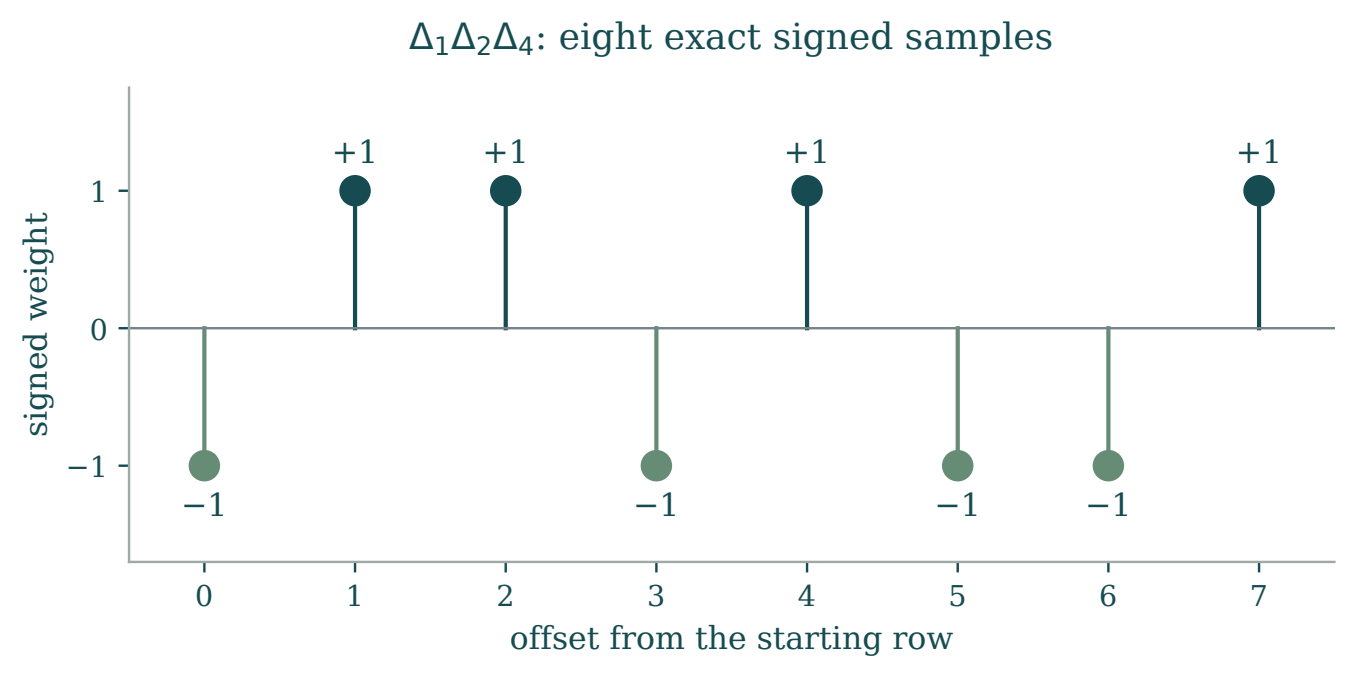
Reading the figure
Each offset from zero through seven has one signed weight, above or below the zero line. The weights come from the exact subset expansion of three commuting differences. The following table retains the offsets and weights from the recorded exact data.
Mathematical labels
\(\Delta_1\Delta_2\Delta_4\): eight exact signed samples
| Offset | Signed weight |
|---|---|
| 0 | -1 |
| 1 | 1 |
| 2 | 1 |
| 3 | -1 |
| 4 | 1 |
| 5 | -1 |
| 6 | -1 |
| 7 | 1 |
Selectable labels from the original PDF
Native PDF text retains the figure’s extraction order. Equations and data tables above provide the reading order.
0 1 2 3 4 5 6 7
offset from the starting row
−1
0
1
signed weight
−1
+1 +1
−1
+1
−1 −1
+1
Δ1Δ2Δ4: eight exact signed samples
Original figure caption
For steps \((1,2,4)\) all eight offsets are distinct. This is an exact signed stencil, rather than an approximate derivative.
For this stencil, the general dyadic bound is
At rank four the factorial theorem improves it to seven for addresses zero and one. Exact rational evaluation gives \(v_2(\Delta_1\Delta_2\Delta_4 C_0(0))=7\). The order is odd, so the mixed-step equality criterion also proves this valuation at every starting row.
There is a prime-power extension. For \(N=p^a\), \(a\ge1\), the sign-corrected operator is
Here \(E^{(N,j)}(n)=E_{Nn}^{(N,j)}\). For an odd prime, an ordinary first difference need not have positive valuation: at address zero its first two normalized values are \(1\) and \(-1\), with difference \(-2\). The sign correction is therefore essential to this prime-power theorem.