
All four rank-four sequences satisfy the sharp first-difference law
For the actual Euler coefficients this becomes
Both laws hold at every starting row and every positive integer step.
Reading the figure
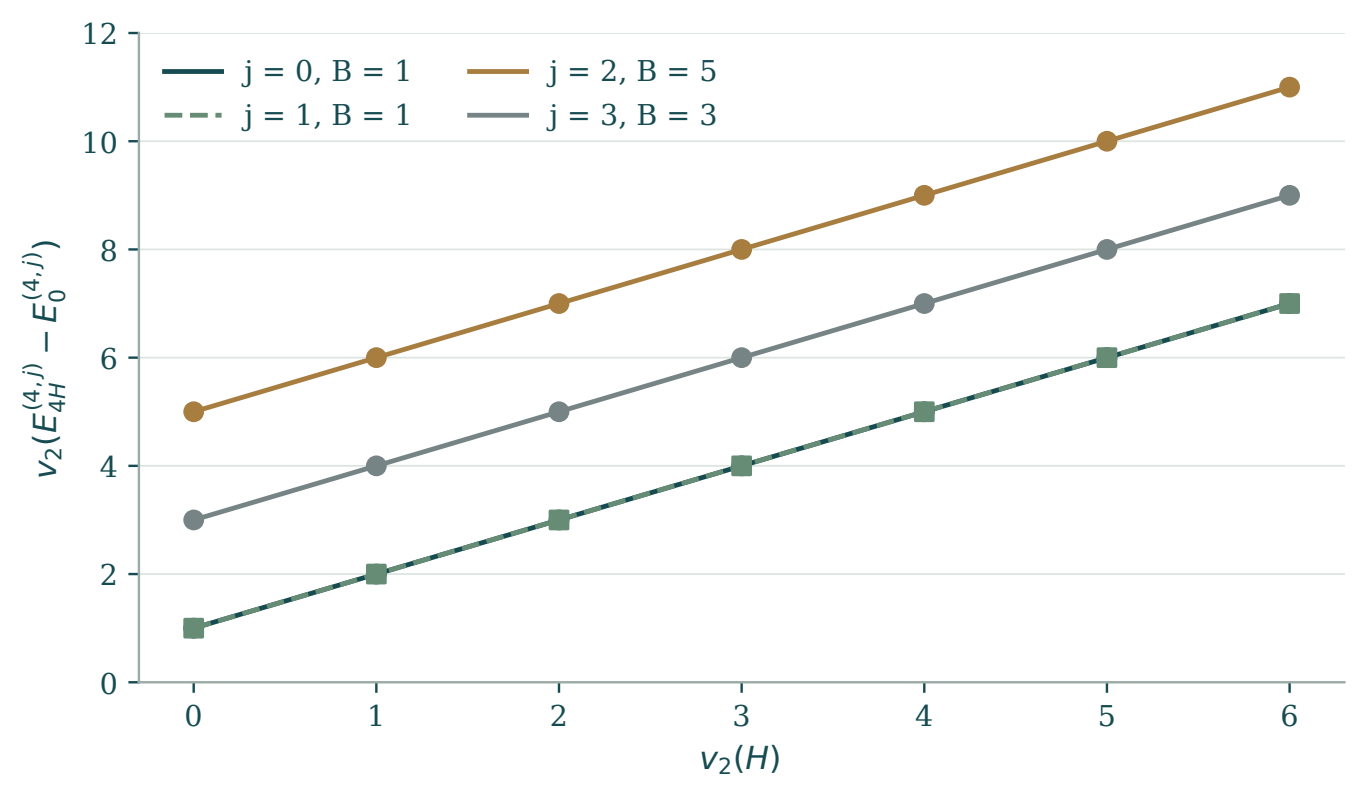
Four lines have slope one, with original Euler scale offsets one, one, five and three for addresses zero through three. Addresses zero and one overlap. Points at step valuations zero through six illustrate the exact arithmetic. The line law is universal; these displayed points are finite illustrations.
Mathematical labels
\(v_2(H)\)
\(v_2(E_{4H}^{(4,j)}-E_0^{(4,j)})\)
Selectable labels from the original PDF
Native PDF text retains the figure’s extraction order. Equations and data tables above provide the reading order.
0
1
2
3
4
5
6
v
2
(
H
)
02468
10
12
v2(E(4, j) 4H − E(4, j) 0 )
j = 0, B = 1
j = 1, B = 1
j = 2, B = 5
j = 3, B = 3
Original figure caption
The proved Euler metric laws, with exact modular sample points at base zero and steps \(H=2^s\). Addresses zero and one have the same scale; their circle and square marks overlap.
In dyadic distance, \(|x|_2=2^{-v_2(x)}\). After continuous interpolation to \(\mathbb Z_2\), the law reads
It says exactly how much the map shrinks distances. It also prevents any hidden collision at finer precision: distinct inputs remain distinct after the known scale is removed.
The scale of address two is \(2^{-5}\) in the original normalization and \(2^{-4}\) in the normalized sequence. Omitting its factor \(2!\) would change the period claimed for the original coefficients.