
The prime-power transfer controls a sign-twisted reciprocal sequence at odd primes. It must not be read as an ordinary-difference theorem for the untwisted coefficients.
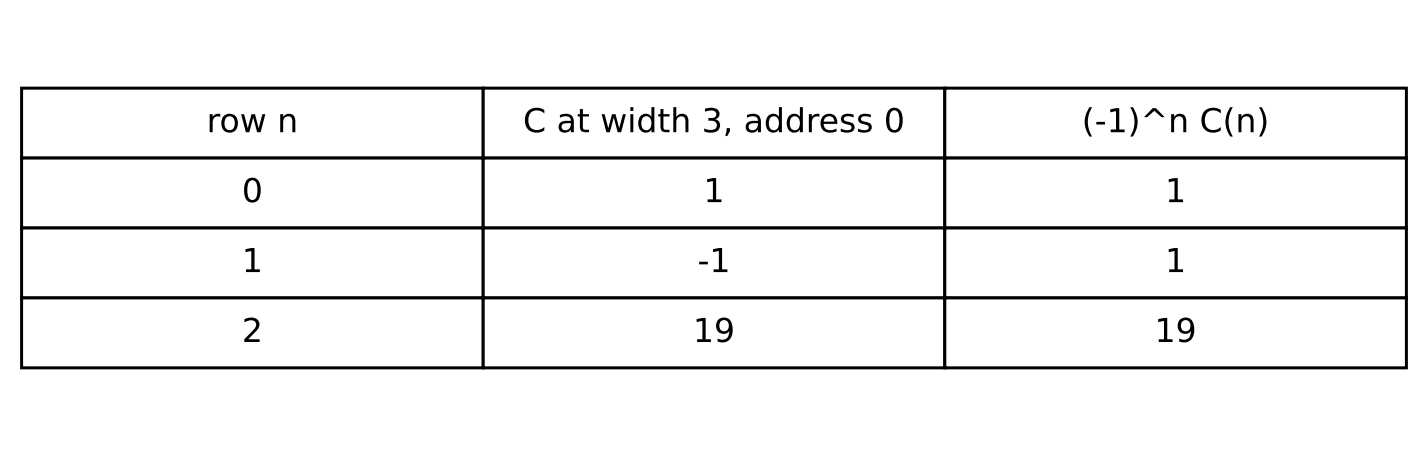
At \(N=p=3\) and \(j=0\), put \(A(n)=(-1)^nC_{3,0}(n)\). The first three rows are
Reading the figure
Rows zero, one and two compare the original normalized coefficients with their alternating-sign twist. The untwisted first difference is minus two, a three-adic unit. The twisted first difference is zero, with infinite valuation. The next twisted difference is eighteen.
| Row | Untwisted C(n) | Sign-twisted C(n) |
|---|---|---|
| 0 | 1 | 1 |
| 1 | -1 | 1 |
| 2 | 19 | 19 |
Selectable labels from the original PDF
Native PDF text retains the figure’s extraction order. Equations and data tables above provide the reading order.
row n C at width 3, address 0 (-1)^n C(n)
0 1 1
1 -1 1
2 19 19
The ordinary first difference at row zero is \(-1-1=-2\). It is a \(3\)-adic unit, so an asserted lower bound of one for that difference would be false. The twisted first difference is zero, whose mathematical valuation is \(+\infty\). At the next row, the twisted difference is \(19-1=18\), of valuation two.
Equivalently, the untwisted sequence is acted on by \(T_H=S^H-(-1)^H\), where \(S\) advances one row. At odd step one this is \(S+1\), not \(S-1\). The zero in the example is handled by a zero-safe divisibility statement rather than a finite valuation equality. The explicit sign and the zero convention are both part of the theorem's interface.