
For addresses \(j=0,1\), put
The valuation equals \(V\) exactly when \(k\) is odd or \(q\) is even.
| Order parity | Number of even steps | Conclusion |
|---|---|---|
| \(k\) odd | either parity | exact valuation \(V\) |
| \(k\) even | \(q\) even | exact valuation \(V\) |
| \(k\) even | \(q\) odd | valuation at least \(V+1\) |
Reading the figure
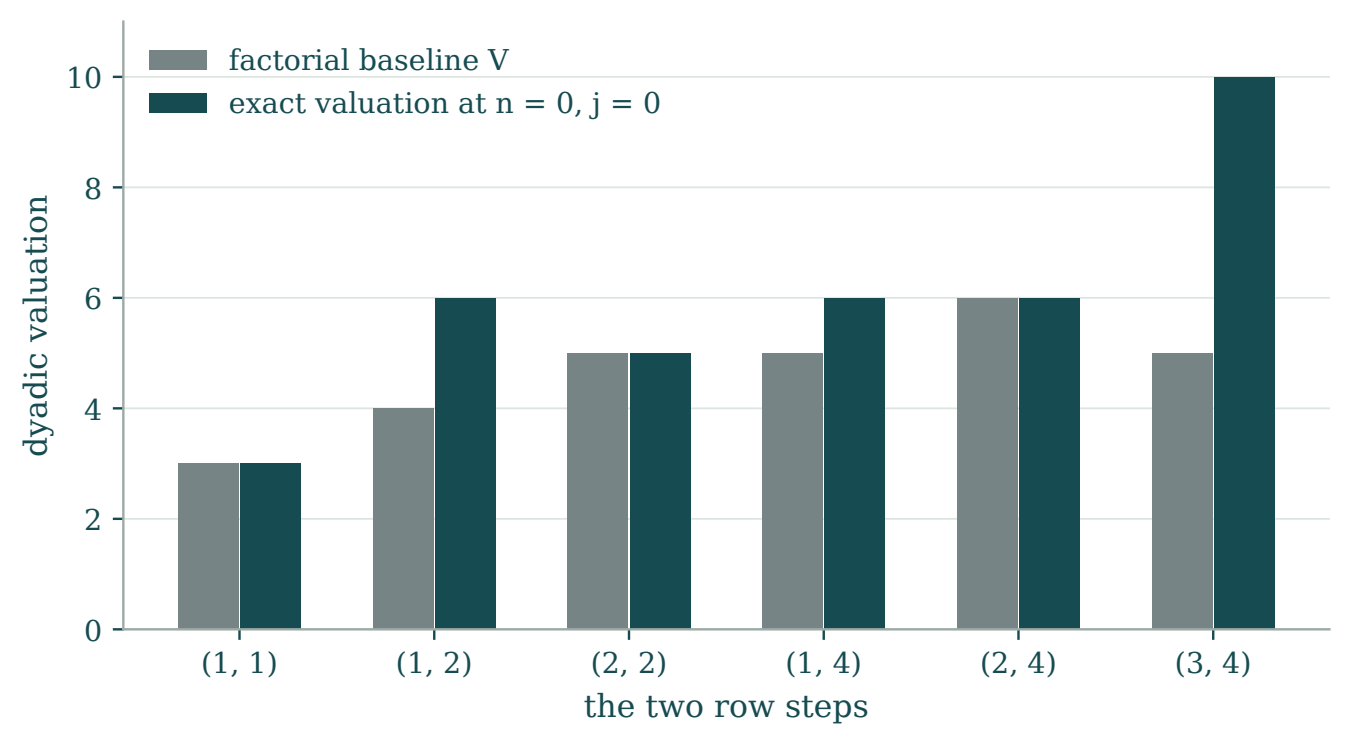
Paired bars compare the factorial baseline with the exact valuation at starting row zero and address zero. A taller exact bar records additional cancellation. The table gives the six pairs and their recorded values; the parity criterion in the source explains when equality holds at every starting row.
| Steps | Baseline | Exact valuation | Exact difference |
|---|---|---|---|
| (1, 1) | 3 | 3 | 72 |
| (1, 2) | 4 | 6 | -33728 |
| (2, 2) | 5 | 5 | 60376672 |
| (1, 4) | 5 | 6 | -288354427328 |
| (2, 4) | 6 | 6 | 3019098102225472 |
| (3, 4) | 5 | 10 | -60921822444127689728 |
Selectable labels from the original PDF
Native PDF text retains the figure’s extraction order. Equations and data tables above provide the reading order.
(1, 1) (1, 2) (2, 2) (1, 4) (2, 4) (3, 4)
the two row steps
0
2
4
6
8
10
dyadic valuation
factorial baseline V
exact valuation at n = 0, j = 0
Original figure caption
Exact rational examples at order two and base zero. Strict cases show why the factorial baseline cannot always be called an equality for mixed steps. The universal parity criterion is proved separately.
For instance,
Cancellation removes the leading term, and here it removes two bits beyond the baseline. The parity theorem proves strictness in this case; it does not give a complete formula for the further depth.
With a common step, \(q\) is either zero or \(k\). Consequently the exceptional parity never occurs, and the homogeneous address-zero/one formula is always exact.