
The map
is a bijective isometry of \(\mathbb Z_2\). Its finite reductions preserve the number of common low binary digits.
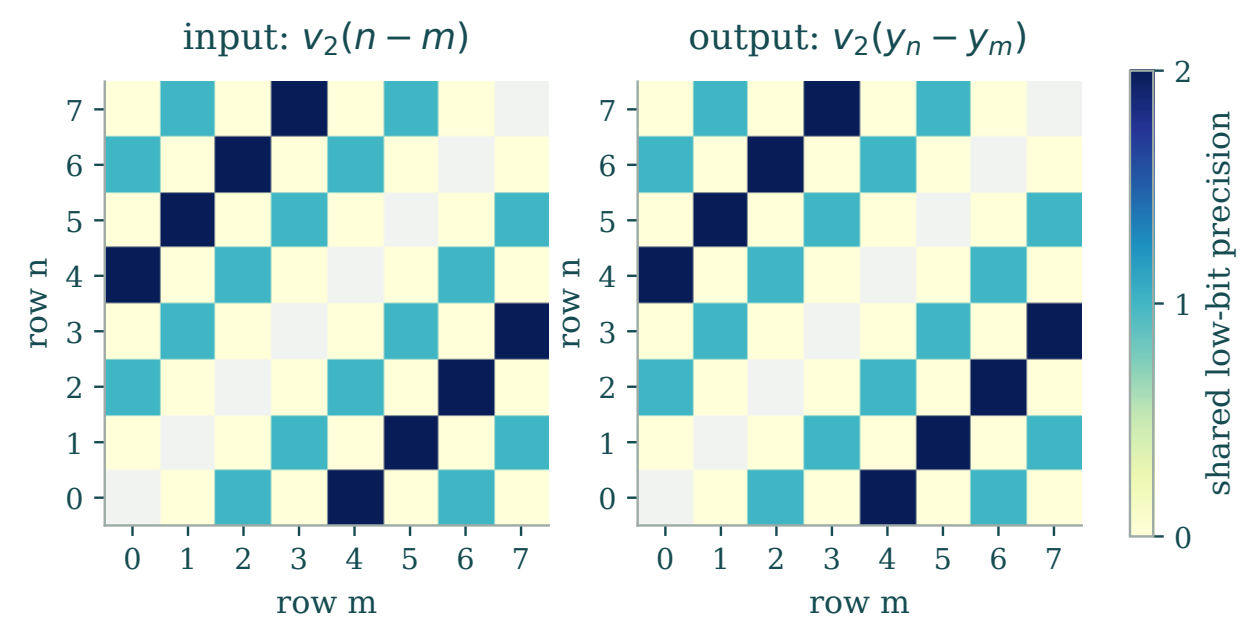
Reading the figure
Both eight-by-eight matrices show the valuation of a difference between two rows. The right matrix uses the scaled output residues from the address-two permutation. Their colors agree at every off-diagonal position. Blank diagonals mean the infinite valuation of zero. The recorded input-output pairs below identify all eight rows without interpreting the blank diagonal as a finite number.
Mathematical labels
input: \(v_2(n-m)\)
output: \(v_2(y_n-y_m)\)
| Row | Euler residue | Scaled residue |
|---|---|---|
| 0 | 2 | 0 |
| 1 | 34 | 1 |
| 2 | 194 | 6 |
| 3 | 226 | 7 |
| 4 | 130 | 4 |
| 5 | 162 | 5 |
| 6 | 66 | 2 |
| 7 | 98 | 3 |
Selectable labels from the original PDF
Native PDF text retains the figure’s extraction order. Equations and data tables above provide the reading order.
0
1
2
3
4
5
6
7
row m
01234567
row n
i
n
p
u
t
:
v
2
(
n
−
m
)
0
1
2
3
4
5
6
7
row m
01234567
row n
o
u
t
p
u
t
:
v
2
(
y
n
−
y
m
)
012
shared low-bit precision
Original figure caption
Address two modulo \(256\) gives an eight-element quotient. The two exact matrices coincide: every pair of distinct rows has the same dyadic valuation before and after the scale is removed. The diagonal represents \(v_2(0)=+\infty\) and is left blank.
If \(n-m\) is odd, the rows disagree in their first binary digit and the matrix entry is zero. If it is divisible by two but not four, they share exactly one low digit. An entry two means agreement through two low digits.
This structure explains the residue permutation in the preceding section. At each new precision, every input residue has exactly two lifts. An isometry distinguishes those lifts at the corresponding output precision. Starting from the single residue at the scale threshold, induction gives surjectivity and a unique inverse residue at every finite level.
The finite matrix is an illustration of that proof. Its eight rows alone would not establish a statement about the whole of \(\mathbb Z_2\).