
Take \(F(x)=x^2-7\) over the \(3\)-adic integers and start with \(x_1=1\) modulo three. If \(F(x_L)=3^Lr_L\), the next representative has the form \(x_{L+1}=x_L+3^Lt_L\). Its correcting digit satisfies
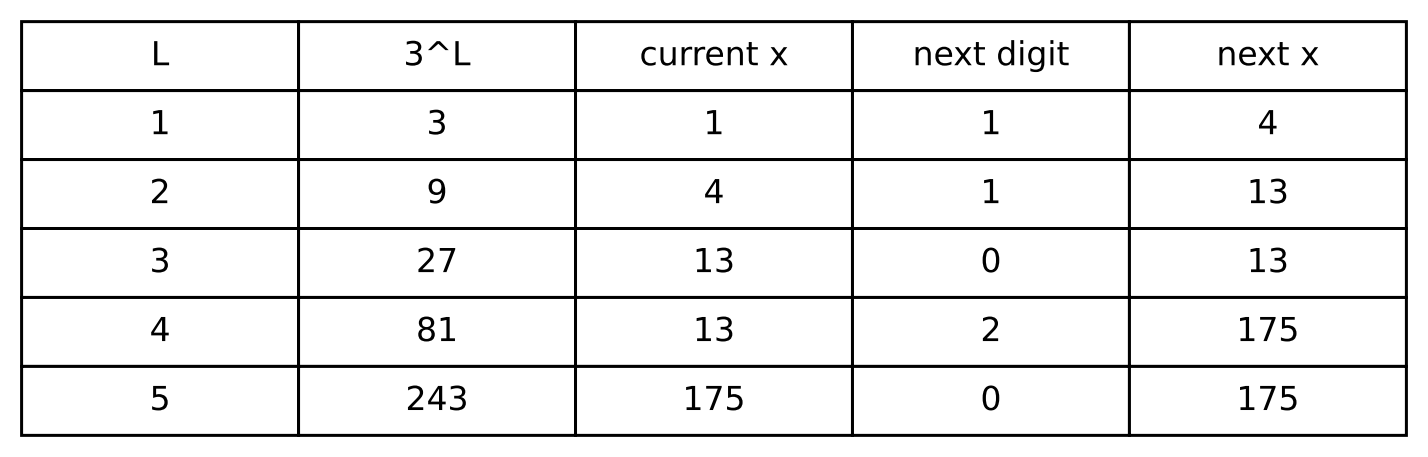
Reading the figure
Rows give the first five stages for a root of x squared minus seven, starting at one modulo three. Each row shows the precision modulus, current representative, correcting digit and next representative. A zero correcting digit preserves compatibility and does not stop the construction.
| Stage | Modulus | Current representative | Digit | Next representative |
|---|---|---|---|---|
| 1 | 3 | 1 | 1 | 4 |
| 2 | 9 | 4 | 1 | 13 |
| 3 | 27 | 13 | 0 | 13 |
| 4 | 81 | 13 | 2 | 175 |
| 5 | 243 | 175 | 0 | 175 |
Selectable labels from the original PDF
Native PDF text retains the figure’s extraction order. Equations and data tables above provide the reading order.
L 3^L current x next digit next x
1 3 1 1 4
2 9 4 1 13
3 27 13 0 13
4 81 13 2 175
5 243 175 0 175
For example, \(F(1)/3=-2\) and \(2x_1=2\), so the next digit is one and \(x_2=4\). Then \(F(4)/9=1\), again giving digit one and \(x_3=13\). At the next stage the residual is divisible by three, so digit zero is correct. A zero digit is not a stalled construction.
Every center remains congruent to one modulo three. Hence \(2x_L\) stays a unit, and the correction equation has a unique digit at every stage. The representatives are compatible and their increments are divisible by \(3^L\). Completeness gives a limit, and continuity of the polynomial gives a root of \(F\). The finite table exhibits the construction. The unit derivative is what supports indefinite continuation.