
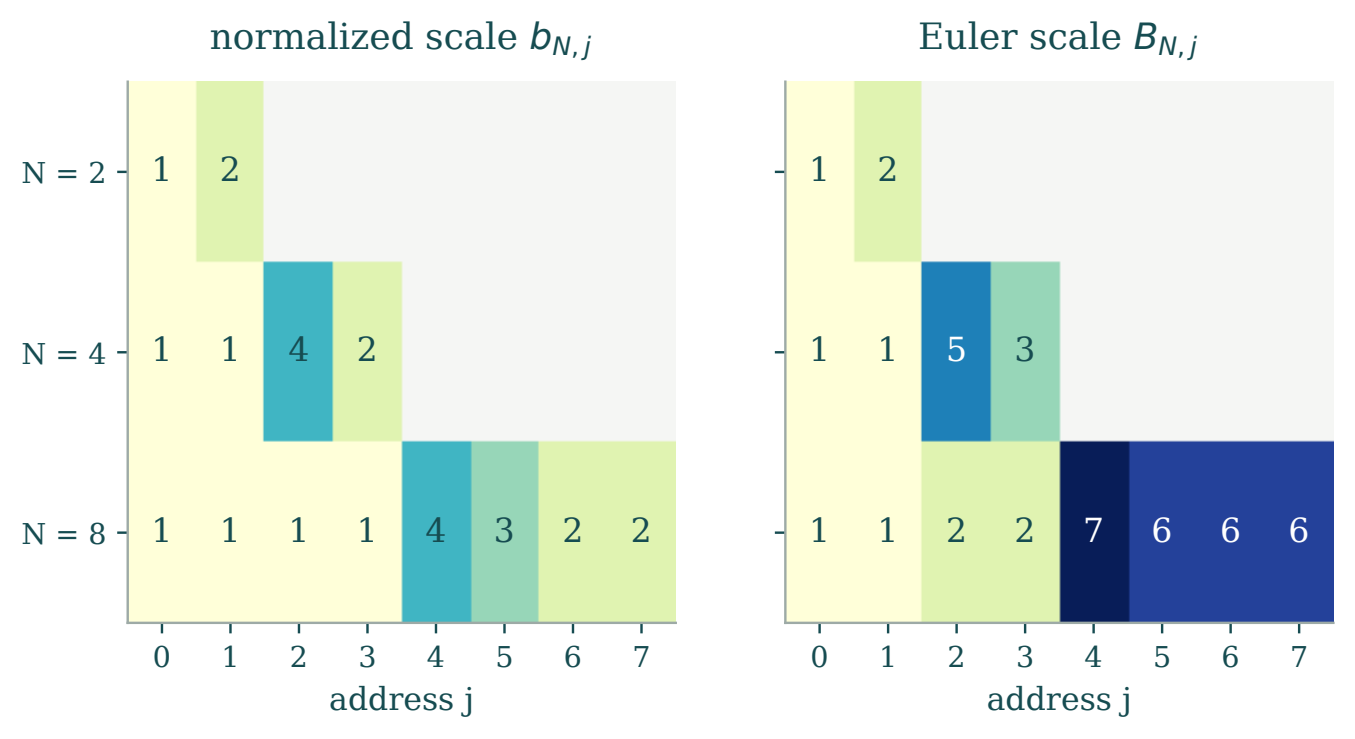
Sharp first-difference laws hold for every address at ranks \(2\), \(4\), and \(8\). The arrays below give their normalized scales \(b_{N,j}\) and original Euler scales \(B_{N,j}=b_{N,j}+v_2(j!)\).
Reading the figure
Two arrays place section rank on the vertical axis and address zero through seven on the horizontal axis. Blank cells are outside the permitted address range. The left entries are normalized scales; the right entries add the valuation of the address factorial. These proved arrays do not extend the same metric law to every higher-rank address.
Mathematical labels
normalized scale \(b_{N,j}\)
Euler scale \(B_{N,j}\)
Selectable labels from the original PDF
Native PDF text retains the figure’s extraction order. Equations and data tables above provide the reading order.
0 1 2 3 4 5 6 7
address j
N = 2
N = 4
N = 8
1 2
1 1 4 2
1 1 1 1 4 3 2 2
normalized scale bN, j
0 1 2 3 4 5 6 7
address j
1 2
1 1 5 3
1 1 2 2 7 6 6 6
Euler scale BN, j
Original figure caption
Proved scale arrays for the three small ranks. Blank cells are outside the address range. The Euler normalization contributes the factorial valuation, which is already substantial at the larger addresses of rank eight.
There is also an infinite family: at every \(N=2^a\ge4\), all lower-half addresses \(j<N/2\) have normalized scale one. Their Euler scale is \(1+v_2(j!)\).
The same constant-scale proposal fails at some upper-half addresses:
| \((N,j)\) | \(v_2(C(1)-C(0))\) | Step-two prediction | Actual step-two valuation |
|---|---|---|---|
| \((16,9)\) | \(5\) | \(6\) | \(7\) |
| \((32,18)\) | \(6\) | \(7\) | \(6\) |
| \((32,19)\) | \(5\) | \(6\) | \(7\) |
These are exact rational counterexamples to the additional metric proposal. They do not contradict the universal higher-difference lower bound, which continues to hold at every address of every dyadic rank.