
Consider the two-component system \(F(x)=(x,x-3)\) at \(x=0\), with \(q=3\) and \(L=1\). Both components vanish modulo three. After writing a candidate as \(y=3t\), its residual vector modulo three is
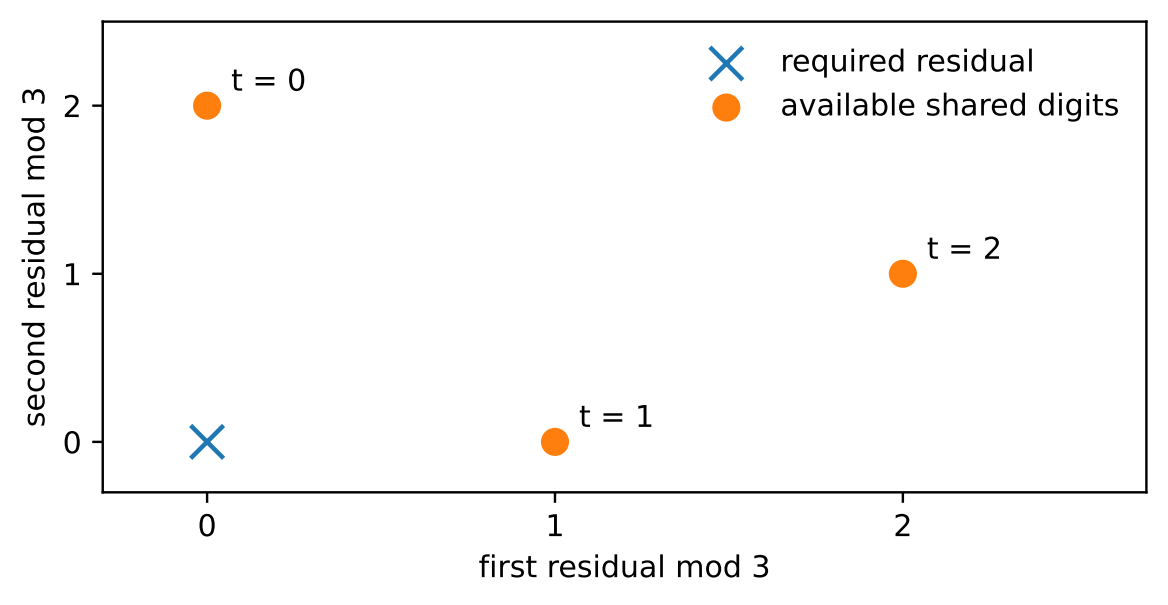
Reading the figure
The required residual is marked at the origin. The three available shared digits give residual pairs (0, 2), (1, 0) and (2, 1). Each coordinate can vanish separately, but no shared digit makes both vanish. The axes are the first and second residuals modulo three.
| Digit | First residual | Second residual |
|---|---|---|
| 0 | 0 | 2 |
| 1 | 1 | 0 |
| 2 | 2 | 1 |
Selectable labels from the original PDF
Native PDF text retains the figure’s extraction order. Equations and data tables above provide the reading order.
0
1
2
first residual mod 3
012
second residual mod 3
t = 0
t = 1
t = 2
required residual
available shared digits
The first coordinate can be corrected by \(t=0\). The second can be corrected by \(t=1\). No digit corrects both. The available residuals are \((0,2)\), \((1,0)\), and \((2,1)\), none of which is \((0,0)\).
The combined Jacobian maps \(t\) to the diagonal vector \((t,t)\). Its image is smaller than the product of its coordinate images. Checking the two projected obstructions independently therefore loses the compatibility condition. The common-correction theorem retains the full residual vector and the shared digit space, which is exactly the information needed to detect this failure.