
At rank four the earlier completed estimate was \(v_2(\Delta_H^k C_j(n))\ge\min(k,n)\). The strengthened theorem reaches every starting row, including \(n=0\), and every order, including \(k>n\).
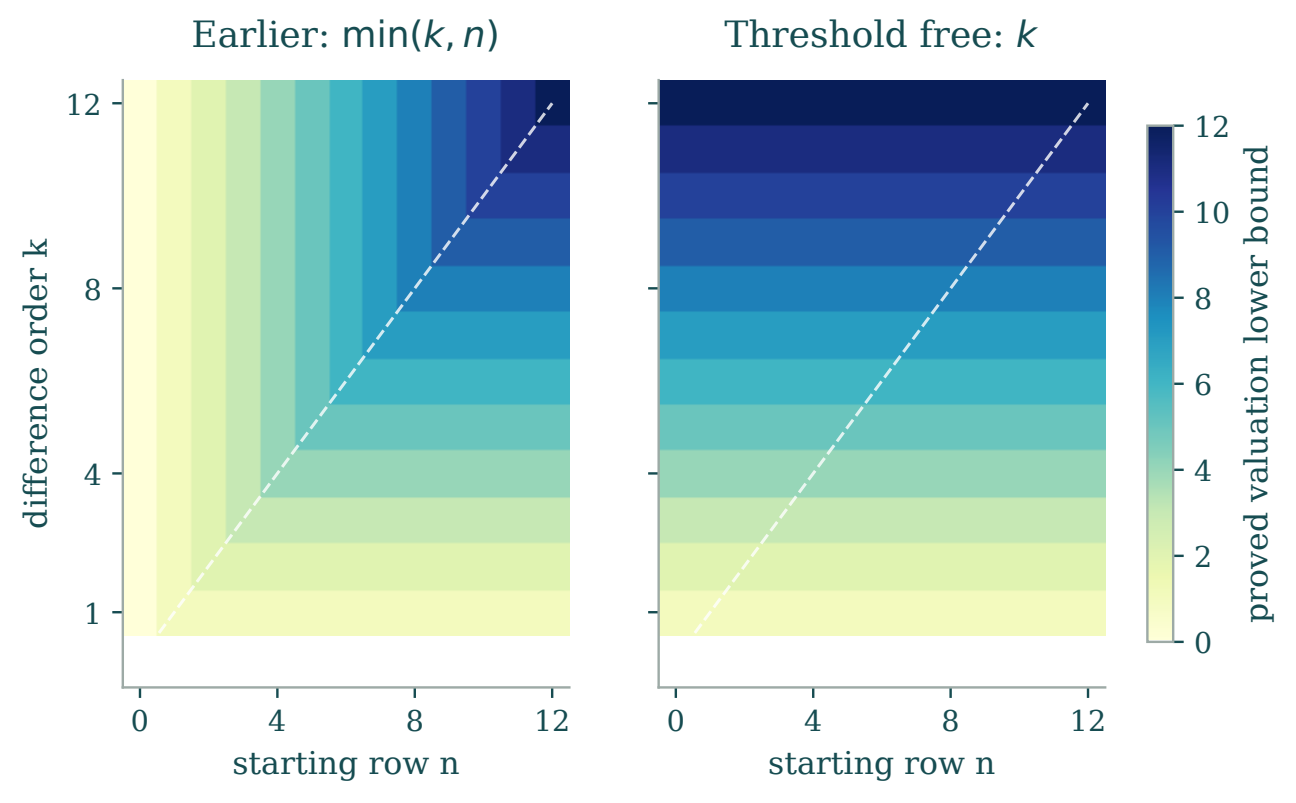
Reading the figure
The two heat maps use starting rows zero through twelve horizontally and difference orders one through twelve vertically. The earlier bound is the smaller of the order and starting row. The new bound is the order throughout each horizontal strip. The dashed diagonal marks equality of the row and order. Colors represent proved bounds, not sampled coefficient valuations.
Mathematical labels
Earlier: \(\min(k,n)\)
Threshold free: \(k\)
Selectable labels from the original PDF
Native PDF text retains the figure’s extraction order. Equations and data tables above provide the reading order.
0
4
8 12
starting row n
148
12
difference order k
E
a
r
l
i
e
r
:
min
(
k
,
n
)
0
4
8 12
starting row n
T
h
r
e
s
h
o
l
d
fr
e
e
:
k
02468
10
12
proved valuation lower bound
Original figure caption
Unit-step lower bounds on a finite display window. Each colored cell is obtained from a proved formula, rather than from sampled coefficients. The dashed line indicates \(k=n\).
For every dyadic section size \(N=2^a\), \(a\ge0\), every permitted address, and all positive steps,
The corresponding statement for \(E_{Nn}^{(N,j)}\) adds \(v_2(j!)\).
The proof acts on the full factorial-scaled power series before it extracts a packed row. This avoids the old extraction constraint \(k\le n\). Reciprocal induction controls the unique term with the highest inverse order in the commuting product expansion; all other terms are covered by the preceding induction stages.
The figure displays the gain at unit step. An even step contributes additional precision, and the theorem permits different steps in the same difference.