
Now take \(F(x)=x^2-3\) at the residue \(x=0\) modulo three. The residual is \(r=F(0)/3=-1\) and the Jacobian is zero modulo three. The next-digit equation would require
which has no solution.
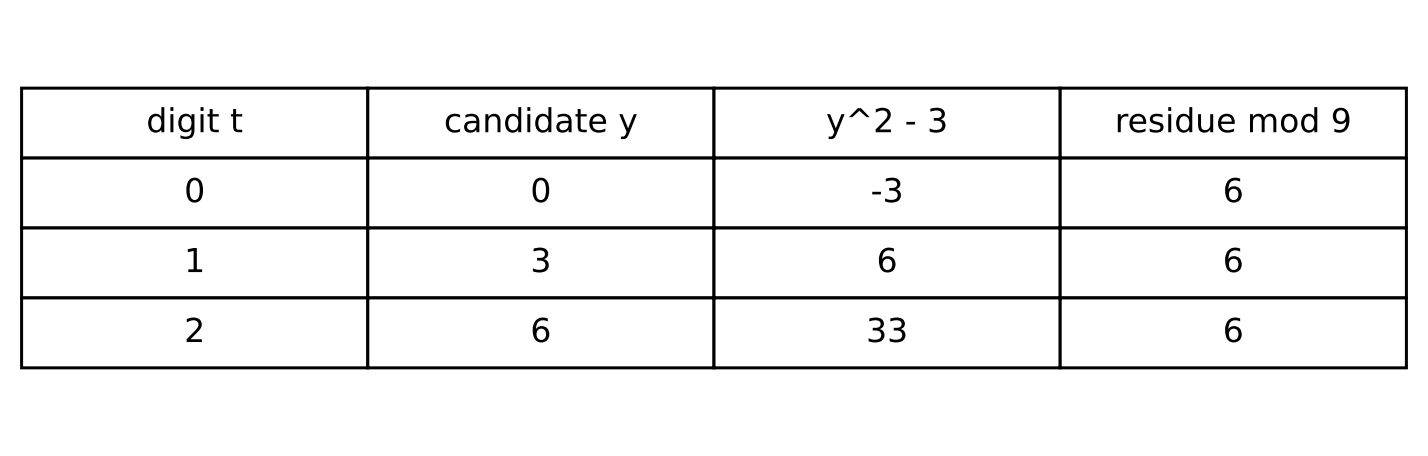
Reading the figure
For x squared minus three, the old root class is zero modulo three. The candidates zero, three and six all leave residue six modulo nine. The table displays every possible next digit and the exact residual. The source also distinguishes singularity with a zero obstruction, where lifts can exist.
| Digit | Residual modulo 9 |
|---|---|
| 0 | 6 |
| 1 | 6 |
| 2 | 6 |
Selectable labels from the original PDF
Native PDF text retains the figure’s extraction order. Equations and data tables above provide the reading order.
digit t candidate y y^2 - 3 residue mod 9
0 0 -3 6
1 3 6 6
2 6 33 6
The three representatives of the old root class modulo nine all leave residual six modulo nine. Thus the root class exists at precision three but does not lift to precision nine. This is an exact obstruction, not failure of an iterative search.
A singular Jacobian alone does not imply failure. For \(F(x)=x^2\) at the same center, the residual is zero and all three candidate digits lift to roots modulo nine. The obstruction is the residual class in the cokernel of the actual Jacobian. It is this class, rather than the rank by itself, that decides whether a next lift exists.