
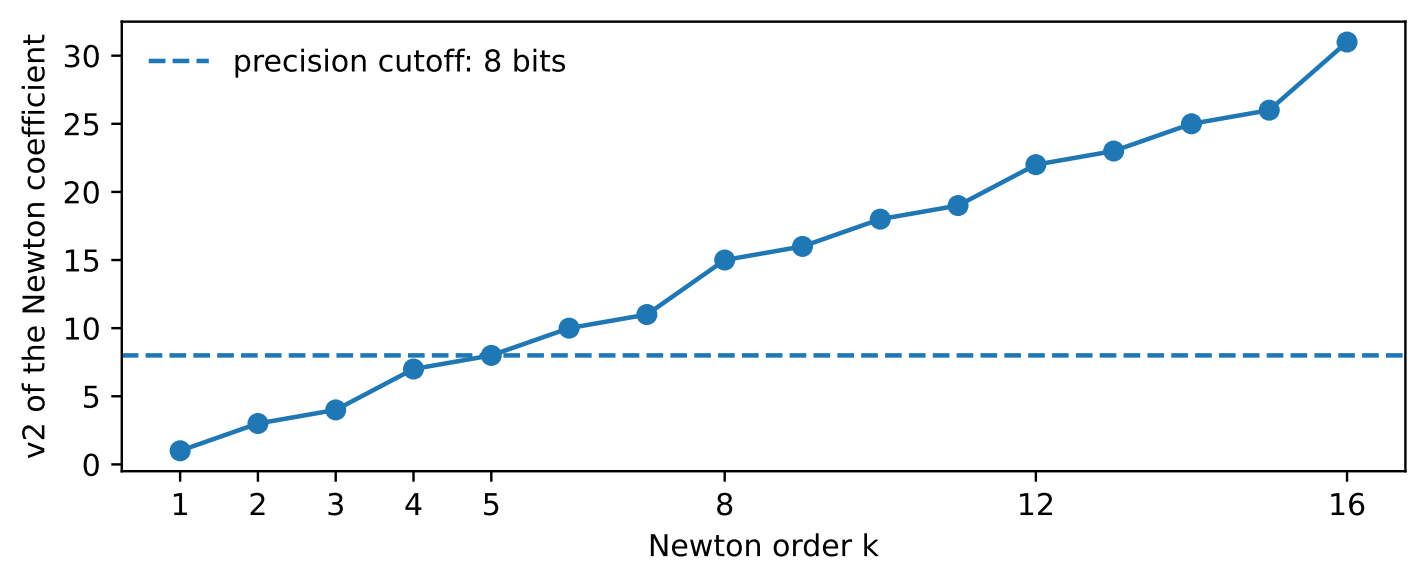
Let \(b_k=\Delta_1^kC_{4,0}(0)\). The first coefficients obtained from the difference triangle are
Permalink · Source line 53 · Included exact Newton coefficients
Reading the figure
Points show the recorded Newton valuations for orders one through sixteen at rank four, address zero. The dashed line is eight bits. Orders five and above lie at or above it. The source uses the coefficient theorem for the uniform truncation and separately records finite reconstruction checks through row thirty-two.
| Order | Valuation |
|---|---|
| 1 | 1 |
| 2 | 3 |
| 3 | 4 |
| 4 | 7 |
| 5 | 8 |
| 6 | 10 |
| 7 | 11 |
| 8 | 15 |
| 9 | 16 |
| 10 | 18 |
| 11 | 19 |
| 12 | 22 |
| 13 | 23 |
| 14 | 25 |
| 15 | 26 |
| 16 | 31 |
Selectable labels from the original PDF
Native PDF text retains the figure’s extraction order. Equations and data tables above provide the reading order.
1
2
3
4
5
8 12 16
Newton order k
05
10
15
20
25
30
v2 of the Newton coefficient
precision cutoff: 8 bits
For this address the proved law is \(v_2(b_k)=2k-s_2(k)\) for \(k\ge1\). Every \(k\ge5\) therefore has \(v_2(b_k)\ge8\). Since \(\binom nk\) is integral, those terms vanish modulo \(256\). Thus, for every \(n\ge0\),
The uniform truncation follows from the coefficient theorem. The script separately checks the exact Newton reconstruction and this reduction for rows \(0\) through \(32\). Those finite checks validate the worked arithmetic without replacing the theorem.