
At every center \(x_0\in\mathbb Z_2\), the interpolations admit ordinary Taylor series \(C_j(x_0+z)=\sum_{d\ge0}a_{j,d}(x_0)z^d\). For positive degrees,
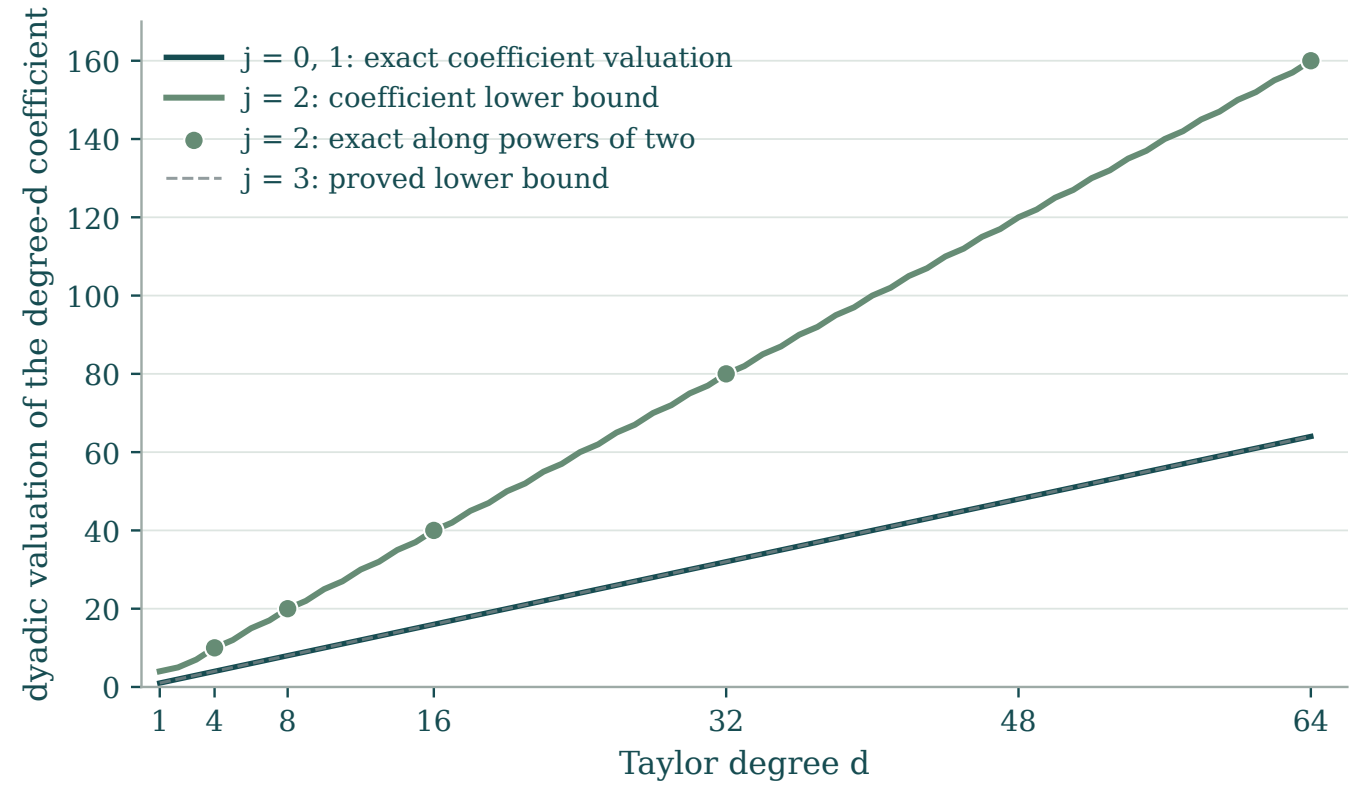
At address two equality with \(5d/2\) holds along every power-of-two degree \(d\ge4\).
Reading the figure
The degree axis runs from one through sixty-four. Addresses zero and one have exact valuation equal to degree. Address three has that same proved lower bound. The address-two lower envelope grows more steeply; powers of two from four onward mark exact values. Degree zero is excluded. The source gives an exact radius for address two and a lower bound for address three.
Selectable labels from the original PDF
Native PDF text retains the figure’s extraction order. Equations and data tables above provide the reading order.
1
4
8 16 32 48 64
Taylor degree d
0
20
40
60
80
100
120
140
160
dyadic valuation of the degree-d coefficient
j = 0, 1: exact coefficient valuation
j = 2: coefficient lower bound
j = 2: exact along powers of two
j = 3: proved lower bound
Original figure caption
The Taylor coefficient precision slopes. The degree-zero coefficient is excluded. Marked address-two degrees belong to an unbounded proved equality family, rather than a finite observed pattern.
The radius is \(2^{\liminf_d v_2(a_d)/d}\) in the normalized dyadic absolute value. Hence
The exact radius of address three is not asserted. For address two, the lower bound gives convergence inside the claimed radius and the unbounded equality family prevents a larger one.
The proof converts the factorial Newton estimates into ordinary Taylor coefficients with the Stirling relations. Generic continuity or first-order Lipschitz bounds alone do not supply this analytic conclusion.