
The visual guide accompanies Euler Congruences: Completion, Factorial Strengthening, and Sharp Dyadic Geometry. It makes the indexing, precision gains, and boundaries of the results visible. The main paper contains the proofs. The separate Lean guide records which statements are already formalized and which belong to the new mathematical extension.
Reading the figure
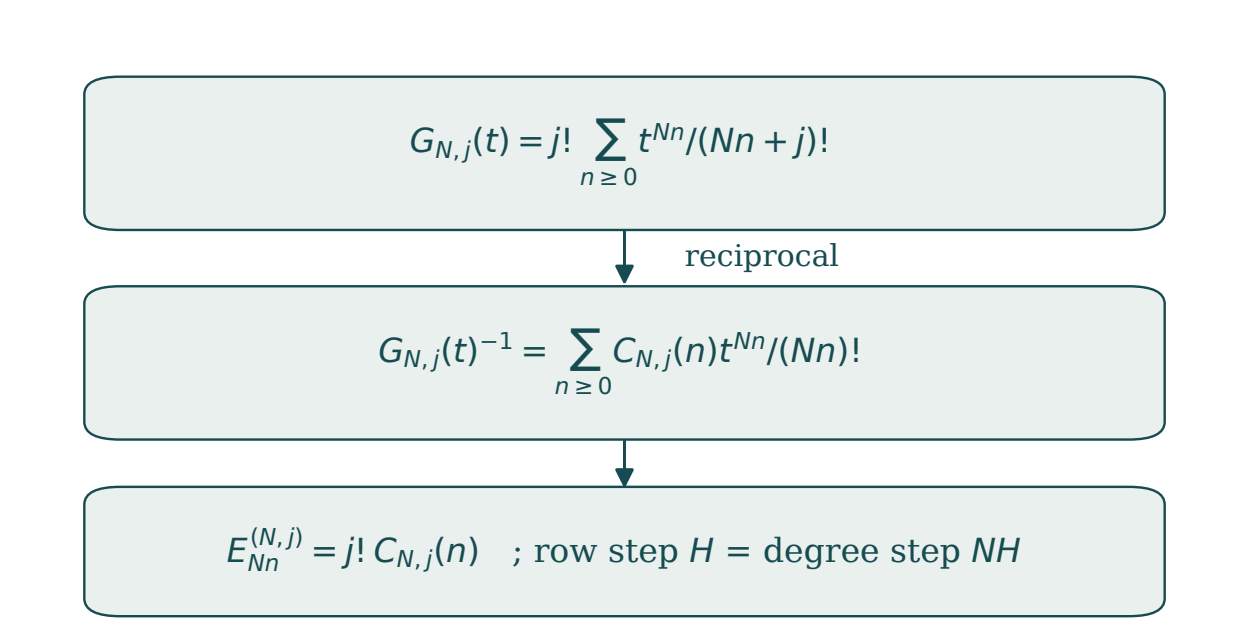
Three boxes run downward from the normalized source series to its reciprocal coefficients and then to the original Euler coefficients. The first arrow takes a reciprocal. The second multiplies by the address factorial. A row step corresponds to the section width times that step in Euler degree.
Mathematical labels
\(G_{N,j}(t)=j!\sum_{n\geq0}t^{Nn}/(Nn+j)!\)
\(G_{N,j}(t)^{-1}=\sum_{n\geq0}C_{N,j}(n)t^{Nn}/(Nn)!\)
\(E_{Nn}^{(N,j)}=j!C_{N,j}(n)\quad\); row step \(H\) = degree step \(NH\)
Selectable labels from the original PDF
Native PDF text retains the figure’s extraction order. Equations and data tables above provide the reading order.
GN, j(t) = j! ∑
n ≥ 0
t
Nn
/(Nn + j)!
GN, j(t)
−1 = ∑
n ≥ 0
CN, j(n)t
Nn
/(Nn)!
reciprocal
E
(N, j)
Nn = j! CN, j(n) ; row step H = degree step NH
Original figure caption
The actual reciprocal series is the source of every coefficient in this guide. The factorial normalization changes valuations as well as the constant term.
There are two coefficient conventions, and they must stay distinct:
The last equality uses \(v_2(0)=+\infty\). Congruences of dyadic rational numbers mean membership in the corresponding ideal of \(\mathbb Z_2\); a displayed rational denominator is invertible modulo \(2^r\) when it is odd.
| Symbol | Meaning | At rank four |
|---|---|---|
| \(n\) | packed row index | Euler degree \(4n\) |
| \(H\) | positive row step | Euler degree step \(4H\) |
| \(k\) | number of differences | order \(k\), independent of \(n\) |
| \(j\) | address within a section | \(0,1,2,3\) |
For example, \(C_{4,1}(1)=-1/5\) and \(C_{4,1}(2)=121/45\). Their difference is \(26/9\), of valuation one. The row difference joins Euler degrees \(4\) and \(8\).