
On \(\ell^2({\mathbb Z})\), declare every integer shift
The seed \(\delta_0\) generates \(\delta_m=S_m\delta_0\). Finite linear combinations give precisely the sequences with finite support. Their norm closure is all of \(\ell^2({\mathbb Z})\).
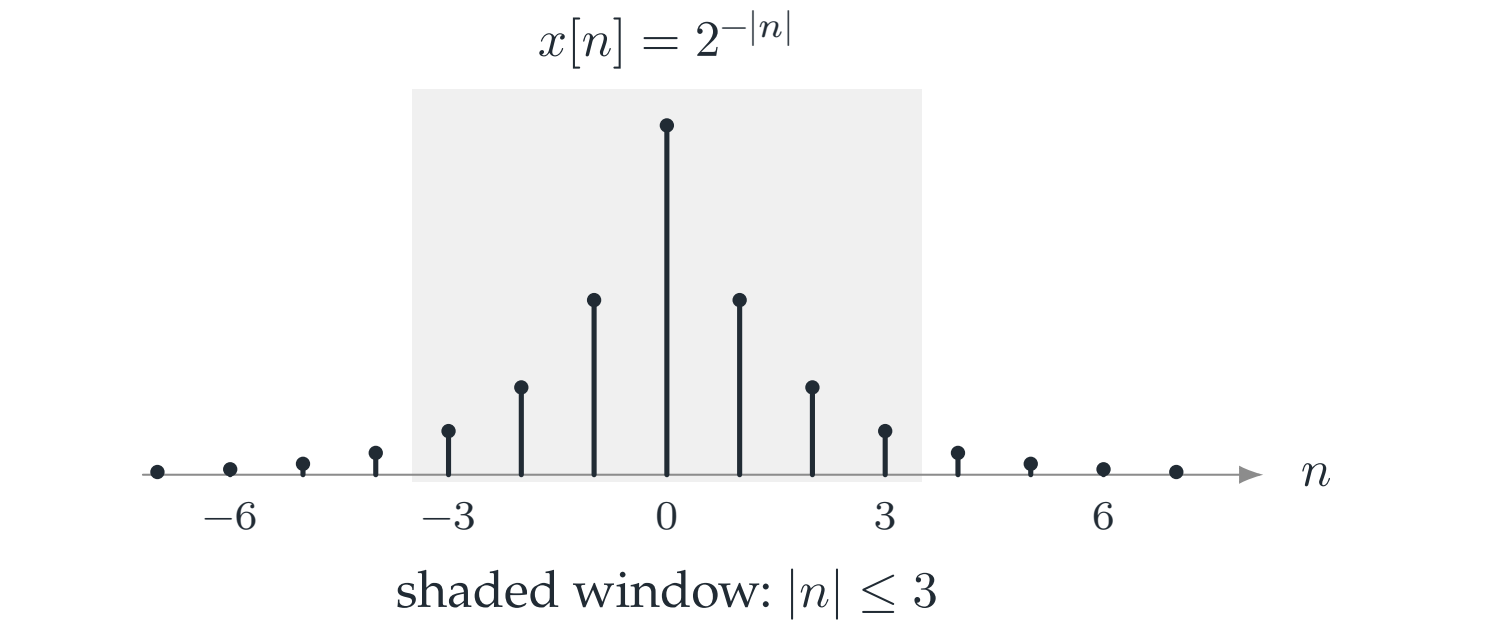
Reading the drawing
Stems display part of the nonzero sequence indexed by all integers. Shading marks the truncation window with absolute index at most three. The omitted tail remains present in the infinite sequence.
Drawing labels and data 8 labels
Read the original labels as selectable text. Tables preserve grid relationships; other short labels are grouped compactly.
- \(-6\)
- \(-3\)
- \(0\)
- \(3\)
- \(6\)
- \(x[n]=2^{-|n|}\)
- shaded window: \(|n|\le3\)
- \(n\)
Evidence note from the source edition
A finite window of the actual sequence \(x[n]=2^{-|n|}\). Outside every finite window, coefficients remain nonzero. The shaded window illustrates the truncation \(x^{(3)}\), not a periodic wraparound.
This \(x\) cannot be a finite linear combination of shifted impulses: it has infinite support. But if \(x^{(N)}\) agrees with \(x\) on \(|n|\le N\) and is zero elsewhere, then
The exact squared errors for \(N=1,3,5\) are \(1/6\), \(1/96\), and \(1/1536\). These are identities from a geometric series, not floating residuals.
What the topology contributes
The statement is that one seed has dense hull. It is not that every vector is a finite word expression. The completion theorem additionally specifies a normed presentation, a dense linear isometry into a Banach target, and the bounded intertwining needed to extend operators.
Read this as
Completion adds limits in a declared topology. A finite numerical window can illustrate the approximants, but cannot be substituted for the infinite object or its convergence proof.