
For \(j=0,1,2\), let \(P_j\) keep the entries with \(n\equiv j\pmod3\). These are bounded orthogonal projectors whose sum is the identity. The packet coordinates can be written as
Reading the drawing
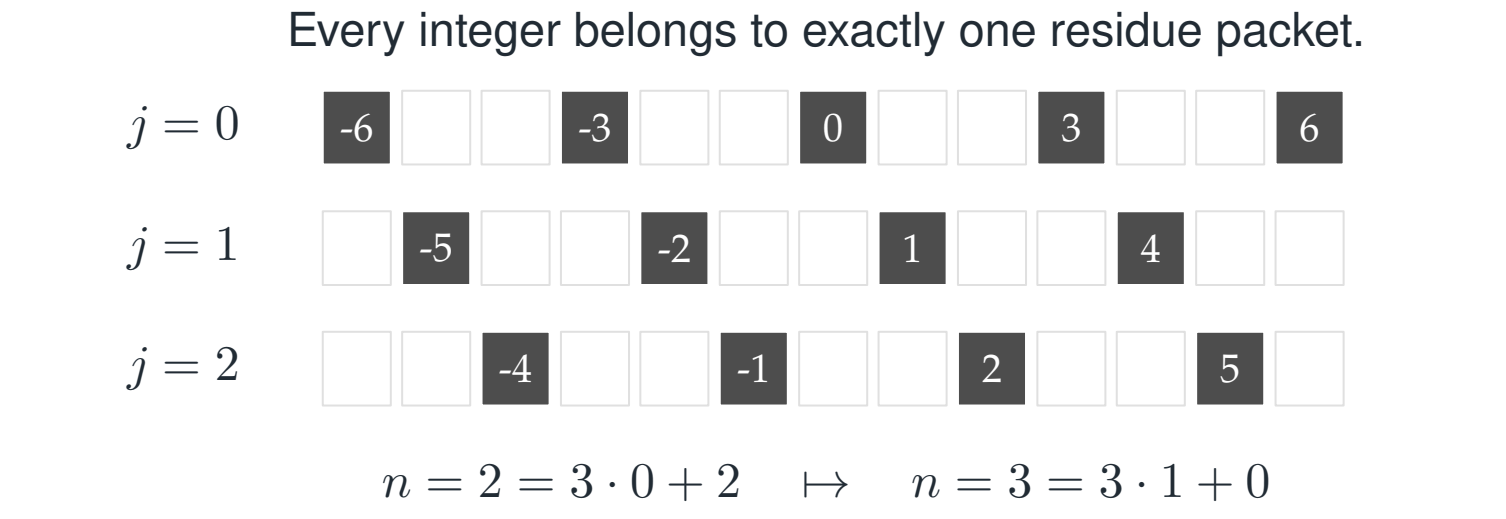
Rows zero, one and two contain their respective integer addresses modulo three. The bottom example follows address two to address three, carrying one step into the coarse index.
Drawing labels and data 18 labels
Read the original labels as selectable text. Tables preserve grid relationships; other short labels are grouped compactly.
- \(j=0\)
- -6
- -3
- 0
- 3
- 6
- \(j=1\)
- -5
- -2
- 1
- 4
- \(j=2\)
- -4
- -1
- 2
- 5
Every integer belongs to exactly one residue packet.
- \(n=2=3\cdot0+2\quad\mapsto\quad n=3=3\cdot1+0\)
Evidence note from the source edition
Each occupied tile represents one integer address in a displayed window. The three rows partition the addresses exactly. Negative indices use the same residue convention.
What one shift does in these coordinates
Let \(S=S_1\) and \(z=Sx\). Substituting \(3k+j\) into the shift definition gives
The passage from phase \(2\) to phase \(0\) carries a shift of the coarse address. If \(Lh[k]=h[k-1]\), the exact packet matrix is
Replacing \(L\) by a scalar \(1\) would preserve the phase graph but would lose the operator's action on the infinite sequences.
Synthesis keeps the positions
To reconstruct \(x\), place \(x_j[k]\) at its original address \(3k+j\). In the ambient space formulation, this is the finite sum \(x=P_0x+P_1x+P_2x\). Boundedness makes the same formulas valid after taking the \(\ell^2\) completion.
Read this as
A cyclic packet graph is only the routing pattern. The block at the phase boundary still carries an actual shift operator.