
A seed does not carry a fixed amount of generative power by itself. The answer depends on the operators that are allowed to act on it. Paper I makes that dependence part of the mathematical object rather than leaving it implicit.
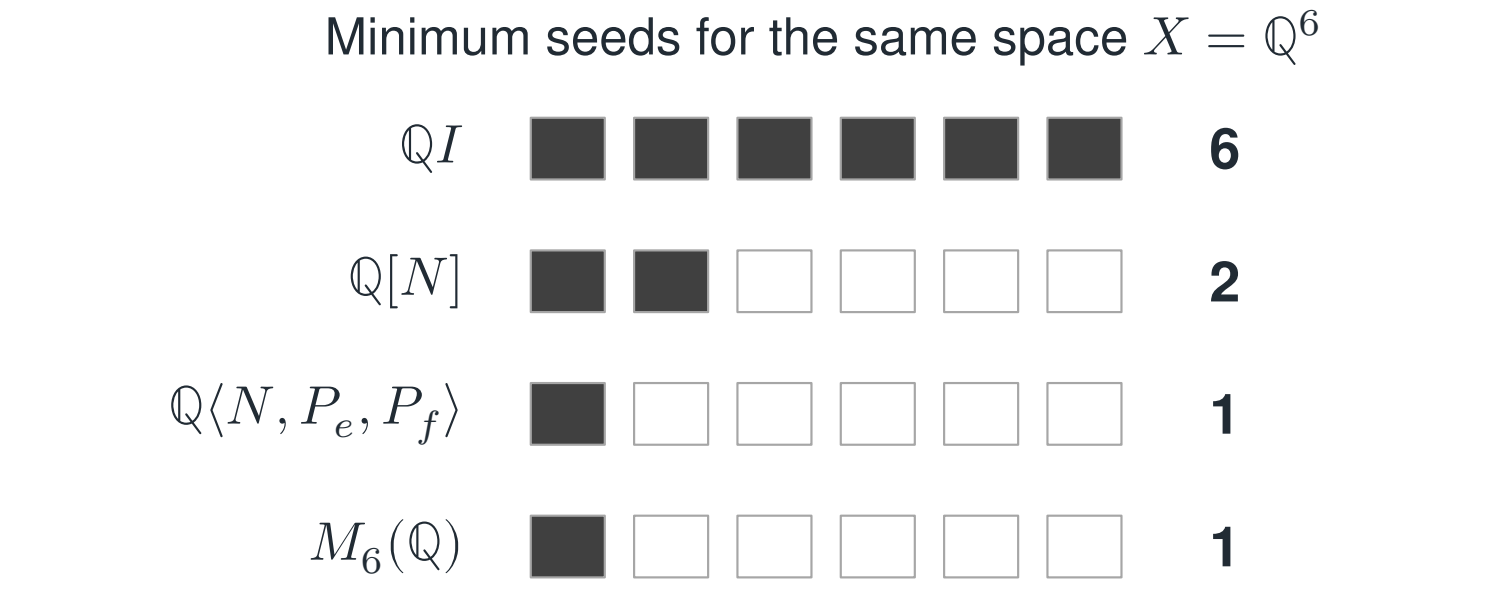
Use the same space of dimension six throughout the first comparison:
Here each \(J_3(0)\) moves a basis vector forward along a chain of three basis vectors. The projectors \(P_e,P_f\) select the two chains. Their formulas and the proofs of the minimum seed counts appear on Visual 3 and Visual 4.
Reading the drawing
Four rows compare the same six-dimensional space under scalar action, a single operator, the operator with chain projectors, and the full matrix algebra. Filled squares and the numbers at right give minimum seed counts; they do not show timings.
Drawing labels and data 9 labels
Read the original labels as selectable text. Tables preserve grid relationships; other short labels are grouped compactly.
| Allowed algebra | Minimum seeds |
|---|---|
| \({\mathbb Q} I\) | 6 |
| \({\mathbb Q}[N]\) | 2 |
| \({\mathbb Q}\langle N,P_e,P_f\rangle\) | 1 |
| \(M_6({\mathbb Q})\) | 1 |
Evidence note from the source edition
A count of minimum generators, not a timing comparison. The ambient space is unchanged. Enlarging the acting algebra changes what one seed can separate.
Three questions to keep apart
| Question | What to ask |
|---|---|
| Generation | Can the fixed grammar reach every vector by finite linear combinations of operator words? |
| [4pt] Coordinates | Can every vector be split into packets and then reconstructed exactly? |
| [4pt] Completion | When finite words do not suffice, does their span become dense in the specified topology? |
A packet projector can be available as a way to inspect a vector without belonging to the generation grammar. Admitting it as a new primitive can lower seed rank. That distinction explains the second and third rows of the figure.
Read this as
The useful question is not “How powerful is this seed?” It is “What does this seed generate under this particular, previously fixed algebra of operators?”