
Let \(F={\Bbbk}\langle z_1,\ldots,z_r\rangle\) be the algebra of noncommuting operator words. Evaluation at a fixed seed is
Two words represent the same generated vector exactly when their difference lies in \(I_s={\operatorname{Ker}}\Phi_s\). Consequently
as left modules. The relation \(f(T)s=0\) implies \(g(T)f(T)s=0\) for every word \(g\), which explains closure under multiplication on the left.
The distinction is visible in two dimensions
Use \(X={\mathbb Q}^2\), seed \(e_1=(1,0)^\mathsf T\), and the full matrix algebra. Its seed annihilator is the set of matrices with zero first column:
Reading the drawing
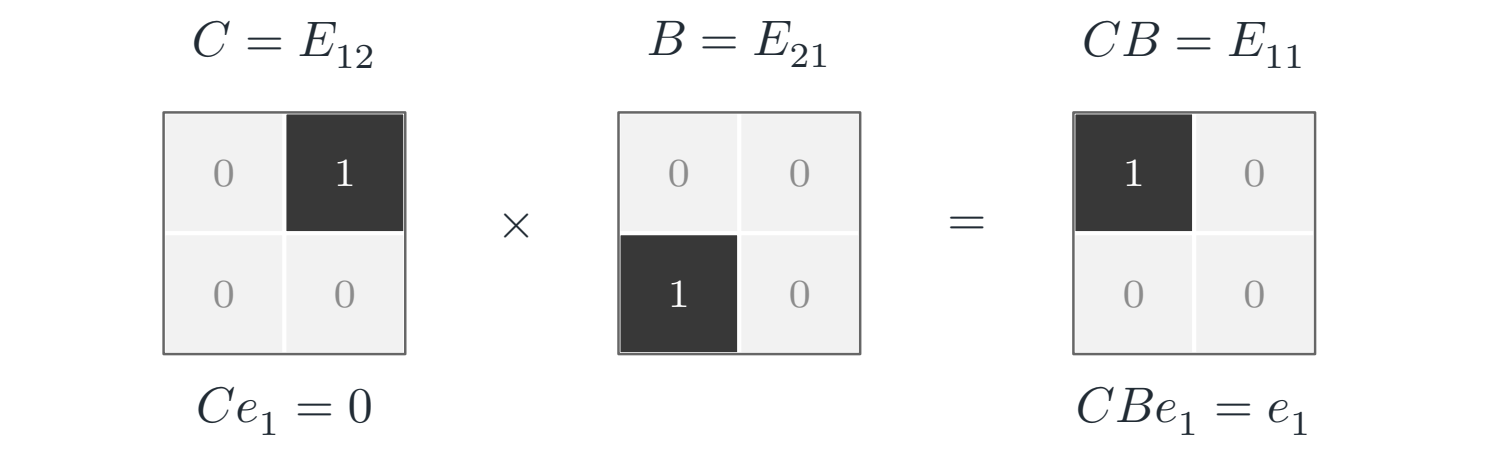
Three matrices display C, B and their product in that order. The source labels show that C kills the seed while CB returns the seed, illustrating the difference between a left ideal and a two-sided ideal.
Drawing labels and data 19 labels
Read the original labels as selectable text. Tables preserve grid relationships; other short labels are grouped compactly.
| Row | Column 1 | Column 2 |
|---|---|---|
| Row 1 | \(0\) | \(1\) |
| Row 2 | \(0\) | \(0\) |
| Row | Column 1 | Column 2 |
|---|---|---|
| Row 1 | \(0\) | \(0\) |
| Row 2 | \(1\) | \(0\) |
| Row | Column 1 | Column 2 |
|---|---|---|
| Row 1 | \(1\) | \(0\) |
| Row 2 | \(0\) | \(0\) |
- \(\times\)
- \(=\)
- \(Ce_1=0\)
- \(CBe_1=e_1\)
Evidence note from the source edition
The relation \(Ce_1=0\) is destroyed by multiplying \(C\) on the right by \(B\). The product \(CB\) sends the seed to itself.
For arbitrary \(D\), \((DC)e_1=D(Ce_1)=0\). But \((CB)e_1=e_1\ne0\). Thus \(I_{e_1}\) is a left ideal, but it is not stable under multiplication on the right. The quotient retains the action on generated vectors. Calling it a ring would lose the distinction that makes the presentation correct.
Several seeds give a module of relations
For \((s_1,\ldots,s_m)\), evaluation is \((f_1,\ldots,f_m)\mapsto\sum_j f_j(T)s_j\). Its kernel is a submodule of \(F^m\) and can include relations between seeds, not only relations annihilating each seed separately.
Read this as
A presentation says which operator expressions are identified in a particular realization. A seed annihilator is not automatically an algebra relation ideal.