
Let \(M_2({\mathbb Q})\) act on \(X=M_{2\times5}({\mathbb Q})\) by left multiplication. Think of the five columns as five copies of the same natural module of dimension two. One seed is a \(2\times5\) matrix \(V\).
Every row of \(AV\) is a linear combination of the two rows of \(V\). Hence one seed exposes at most two independent directions in the multiplicity space of dimension five. Two seeds expose at most four. At least three are necessary.
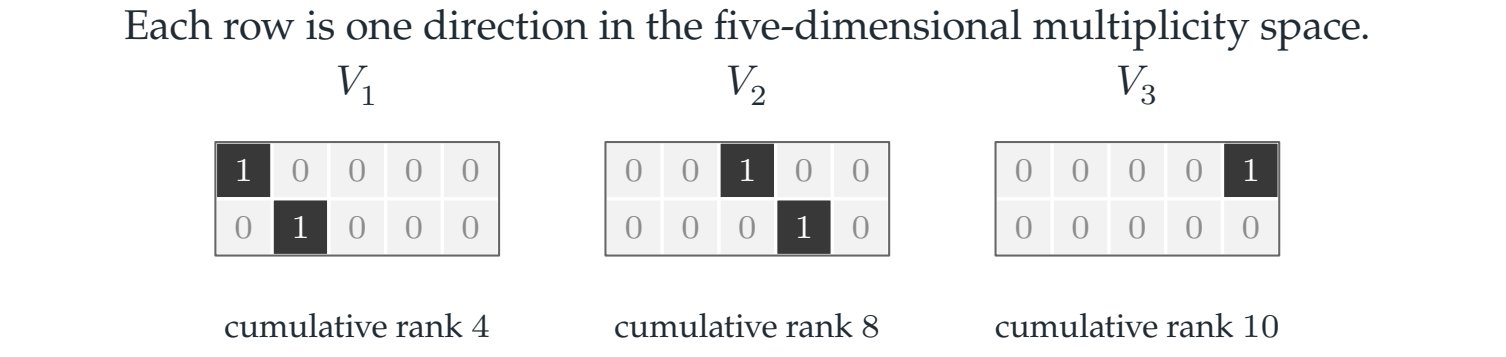
Reading the drawing
Three two-by-five seed matrices show the row directions supplied in sequence. Their labeled cumulative orbit dimensions are four, eight and ten.
Drawing labels and data 37 labels
Read the original labels as selectable text. Tables preserve grid relationships; other short labels are grouped compactly.
| Row | Column 1 | Column 2 | Column 3 | Column 4 | Column 5 |
|---|---|---|---|---|---|
| Row 1 | \(1\) | \(0\) | \(0\) | \(0\) | \(0\) |
| Row 2 | \(0\) | \(1\) | \(0\) | \(0\) | \(0\) |
| Row | Column 1 | Column 2 | Column 3 | Column 4 | Column 5 |
|---|---|---|---|---|---|
| Row 1 | \(0\) | \(0\) | \(1\) | \(0\) | \(0\) |
| Row 2 | \(0\) | \(0\) | \(0\) | \(1\) | \(0\) |
| Row | Column 1 | Column 2 | Column 3 | Column 4 | Column 5 |
|---|---|---|---|---|---|
| Row 1 | \(0\) | \(0\) | \(0\) | \(0\) | \(1\) |
| Row 2 | \(0\) | \(0\) | \(0\) | \(0\) | \(0\) |
- cumulative rank \(4\)
- cumulative rank \(8\)
- cumulative rank \(10\)
Each row is one direction in the five-dimensional multiplicity space.
Evidence note from the source edition
The three fixed seeds cover multiplicity directions \(1,2\), then \(3,4\), then \(5\). The exact dimensions of their cumulative matrix orbits are \(4,8,10\).
An explicit synthesis, not just dimension counting
For
choose \(A_1\) from columns \(1,2\) of \(W\), \(A_2\) from columns \(3,4\), and \(A_3\) with first column equal to column \(5\) of \(W\) and second column zero. Then
The same construction works for arbitrary entries of \(W\), so the lower bound is attained:
Several split simple blocks
If the acting algebra and module are supplied in compatible product coordinates, the row budget is computed separately in each block and the formula for independent actions takes the maximum. For block data \((d,m)=(2,5)\) and \((3,4)\), the result is \(\max(3,2)=3\), not \(3+2\).
Read this as
The formula measures multiplicity directions per seed. The formal development constructs compatible semisimple decompositions; the split formula uses the displayed algebra and module equivalences.