
The paper's typed model has a rotation \(R:U\to U\), an inclusion \(A:U\to V\), and a retraction \(B:V\to U\):
The typed relation is \(BA=I_U\). In the opposite order,
The missing direction is \({\operatorname{Ker}} B={\mathbb Q} v_3\), not an entirely missing vertex.
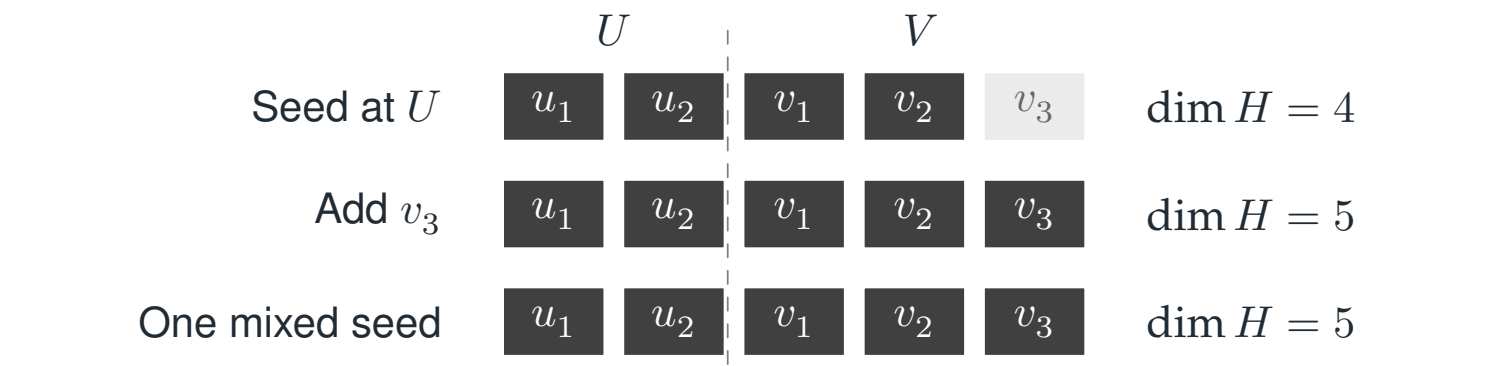
Reading the drawing
Three rows show the basis directions at U and V. With the seed supported at U, the v3 slot is unfilled and the hull has dimension four. Adding the pure v3 seed, or using the displayed mixed seed, fills all five directions.
Drawing labels and data 23 labels
Read the original labels as selectable text. Tables preserve grid relationships; other short labels are grouped compactly.
- Seed at \(U\)
- \(u_1\)
- \(u_2\)
- \(v_1\)
- \(v_2\)
- \(v_3\)
- \(\dim H=4\)
- Add \(v_3\)
- \(u_1\)
- \(u_2\)
- \(v_1\)
- \(v_2\)
- \(v_3\)
- \(\dim H=5\)
- One mixed seed
- \(u_1\)
- \(u_2\)
- \(v_1\)
- \(v_2\)
- \(v_3\)
- \(\dim H=5\)
- \(U\)
- \(V\)
Evidence note from the source edition
Dark slots indicate independent directions in the generated hull. The same two vertex types are present in every row, but their generated subspaces differ.
One seed supported at \(U\)
The vectors \(u_1,Ru_1\) span \(U\). Their images under \(A\) span \({\mathbb Q} v_1+{\mathbb Q} v_2\). Every path from \(U\) to \(V\) ends with \(A\), so it cannot supply \(v_3\). The hull has dimension four. Adding the pure seed \(v_3\) gives all five dimensions.
Why this does not prove an unrestricted minimum of two
The bound path algebra includes the vertex idempotents \(P_U,P_V\). A mixed seed
satisfies \(P_Us=u_1\) and \(P_Vs=v_3\). It therefore generates the entire representation by itself. The paper proves that no seed supported at \(U\) is enough and that two displayed pure seeds suffice. It does not claim that two arbitrary mixed seeds are necessary.
Read this as
Keep three notions separate: reaching a vertex, filling its entire vector space, and minimizing seeds when each seed must lie in a single packet. They answer different questions.