
Let a single operator \(D\) on \({\mathbb Q}^4\) act by
Every vertex of its transfer graph for the coordinate packets is reachable from vertex \(1\). Nevertheless,
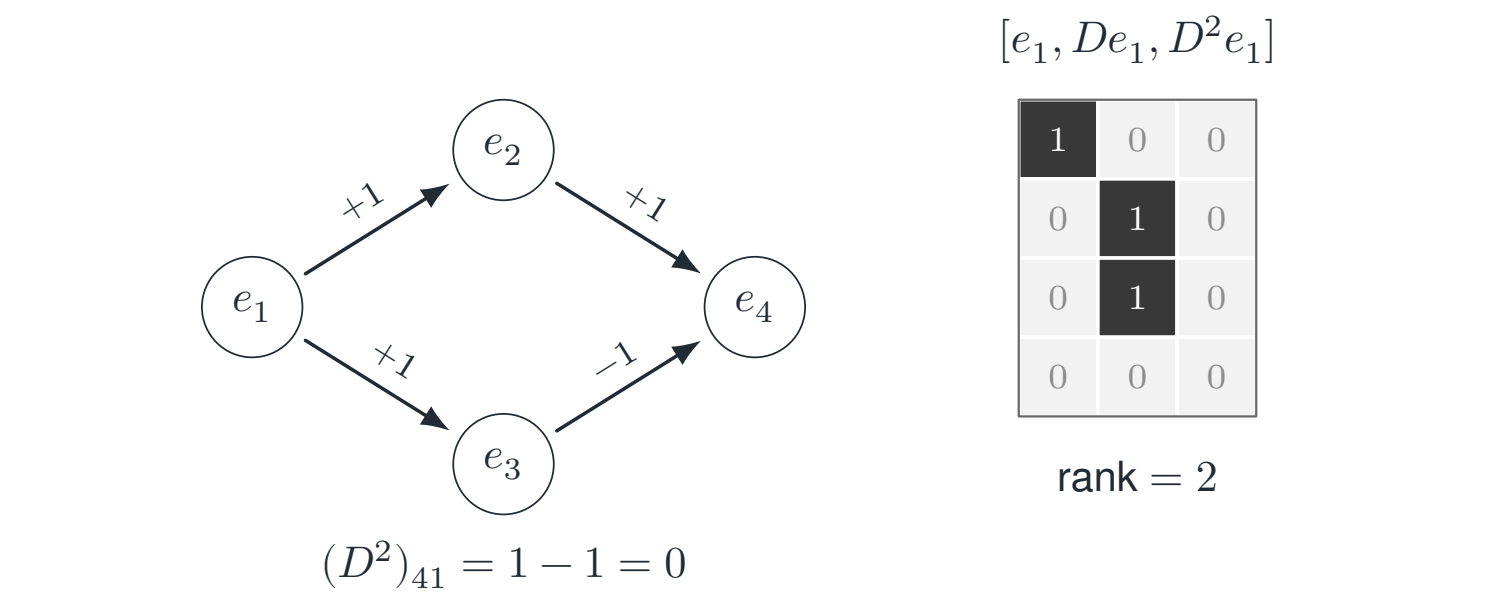
Reading the drawing
A weighted diamond gives two routes from the first vertex to the fourth. Their signed contributions cancel. The adjacent Krylov matrix records the resulting orbit and its rank.
Drawing labels and data 23 labels
Read the original labels as selectable text. Tables preserve grid relationships; other short labels are grouped compactly.
- \(e_1\)
- \(e_2\)
- \(e_3\)
- \(e_4\)
- \(+1\)
- \(+1\)
- \(+1\)
- \(-1\)
| Row | Column 1 | Column 2 | Column 3 |
|---|---|---|---|
| Row 1 | \(1\) | \(0\) | \(0\) |
| Row 2 | \(0\) | \(1\) | \(0\) |
| Row 3 | \(0\) | \(1\) | \(0\) |
| Row 4 | \(0\) | \(0\) | \(0\) |
- rank \(=2\)
- \((D^2)_{41}=1-1=0\)
Evidence note from the source edition
The diamond is the actual weighted action of \(D\). The two paths of length two exist, but their contributions to the same transfer block sum to zero.
What the seed generates
With the fixed algebra \({\mathbb Q}[D]\) and seed \(e_1\),
It has dimension two, not four. Both the independent difference \(e_2-e_3\) and the last coordinate \(e_4\) are missing.
Why projecting in the middle changes the experiment
If \(P_2\) becomes an admissible primitive, the word \(DP_2D\) satisfies
But \(P_2\) was not an allowed generator of the original \({\mathbb Q}[D]\) grammar. Using it to argue that the original seed already reached \(e_4\) would silently enlarge the algebra.
Read this as
Unreachable nonzero packets obstruct generation. Reachability by itself does not prove generation: coefficients can cancel, blocks can have small images, and intermediate projectors may not be admissible.