
Let \(A\) be the adjacency matrix of the path with five vertices. The \((i,j)\) entry of
counts walks of length \(j-1\) from vertex \(1\) to vertex \(i\).
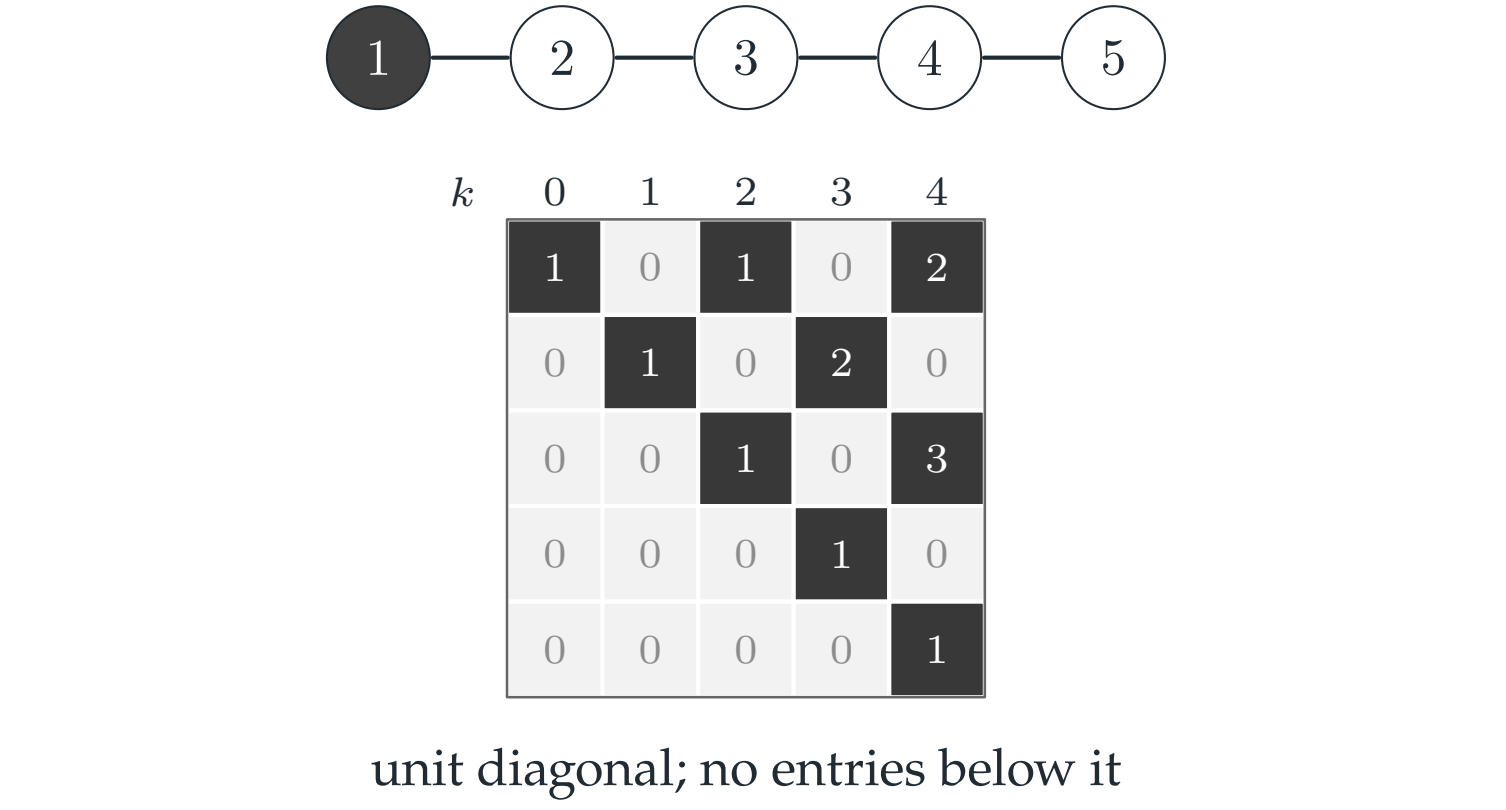
Reading the drawing
The dark endpoint is the seed. The matrix rows correspond to graph vertices and its columns to powers of the adjacency operator. Its entries count walks and expose the unit triangular structure.
Drawing labels and data 37 labels
Read the original labels as selectable text. Tables preserve grid relationships; other short labels are grouped compactly.
| \(k\) | \(0\) | \(1\) | \(2\) | \(3\) | \(4\) |
|---|---|---|---|---|---|
| \(1\) | \(1\) | \(0\) | \(1\) | \(0\) | \(2\) |
| \(2\) | \(0\) | \(1\) | \(0\) | \(2\) | \(0\) |
| \(3\) | \(0\) | \(0\) | \(1\) | \(0\) | \(3\) |
| \(4\) | \(0\) | \(0\) | \(0\) | \(1\) | \(0\) |
| \(5\) | \(0\) | \(0\) | \(0\) | \(0\) | \(1\) |
- unit diagonal; no entries below it
Evidence note from the source edition
The entries are walk counts. At each new power, a new furthest vertex appears with coefficient one. The dark graph vertex is the seed.
A walk cannot reach vertex \(i\) in fewer than \(i-1\) steps. Therefore entries below the diagonal vanish. There is exactly one walk of length \(i-1\) from the first vertex to vertex \(i\): the shortest path. The diagonal entries are all one, so \(\det K=1\).
The same reason works at every size
For a path with any \(n\ge1\), the endpoint Krylov matrix is upper triangular with unit diagonal. This is a combinatorial proof of cyclicity over every field. It does not rely on numerical eigenvalues. The appendix checks the finite cases \(1\le n\le12\) as implementation examples, separately from the paper's proof for every path size.
Read this as
The endpoint distinguishes distances. Each extra operator power reveals one genuinely new coordinate before the finite space is exhausted.