
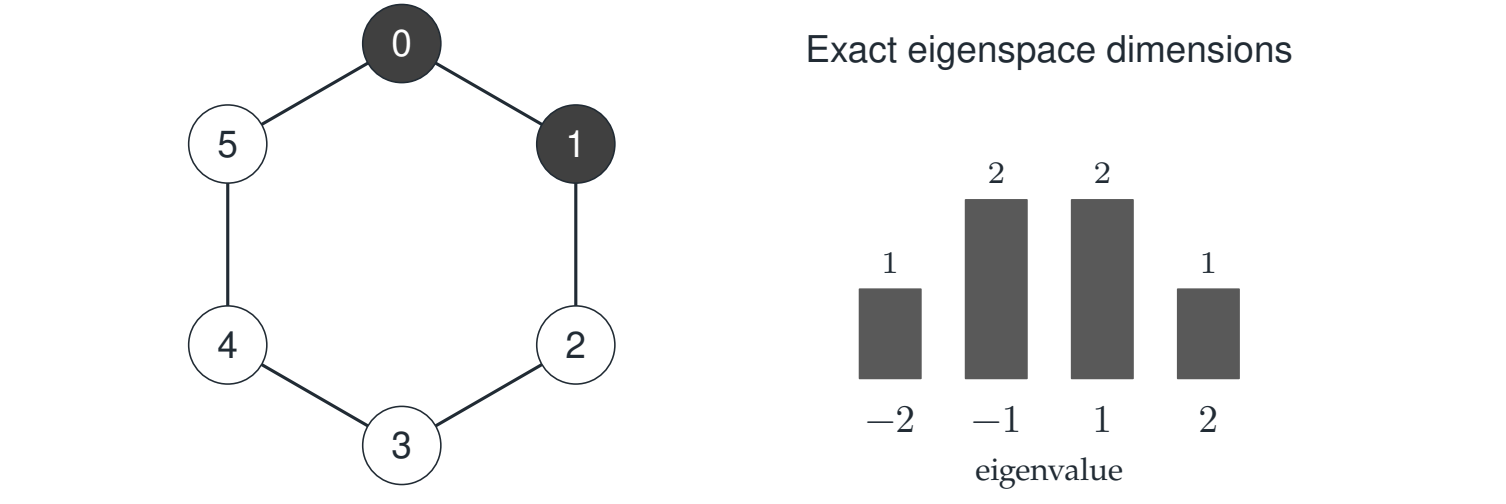
For the adjacency matrix \(A\) of \(C_6\), the distinct eigenvalues are \(2,1,-1,-2\), with multiplicities \(1,2,2,1\). A single vertex seed spans only four directions. Two adjacent vertex seeds span all six.
Reading the drawing
Two dark vertices identify the displayed generating pair on the six-cycle. The bars at right give exact eigenspace dimensions at the labeled eigenvalues; they are not a sampled frequency spectrum.
Drawing labels and data 16 labels
Read the original labels as selectable text. Tables preserve grid relationships; other short labels are grouped compactly.
- 0
- 1
- 2
- 3
- 4
- 5
- \(-2\)
- \(1\)
- \(-1\)
- \(2\)
- \(1\)
- \(2\)
- \(2\)
- \(1\)
- Exact eigenspace dimensions
- eigenvalue
Evidence note from the source edition
The two dark vertices are the displayed generating pair. The bars show exact eigenspace dimensions, not estimated spectral peaks.
A lower bound without a numerical eigensolver
The two rows of the following matrix are independent and obey \(qA=q\):
Thus \(q:{\mathbb Q}^6\twoheadrightarrow{\mathbb Q}^2\) is a scalar quotient for the eigenvalue \(1\). Its extension over \({\mathbb C}\) gives the same obstruction of dimension two. The orbit of any single seed projects to a line, so no single seed can generate the full module.
The matching construction
From adjacent vertex vectors \(e_0,e_1\), the identity
recovers successive vertices around the cycle. The lower and upper bounds therefore give two seeds for this example. The paper proves the corresponding minimum for every complex simple cycle of size at least three.
Read this as
Connectedness is not cyclicity for the adjacency grammar. If a directed cyclic shift were allowed instead, one vertex would generate the whole cycle. That would be a different operator algebra.