
If \((x_i)\) generates \(X\) under \(\AA\) and \((y_j)\) generates \(Y\) under \({\mathcal B}\), then the candidate tensor seeds are all \(x_i\otimes y_j\). For finite expansions,
bilinearity gives the required double sum:
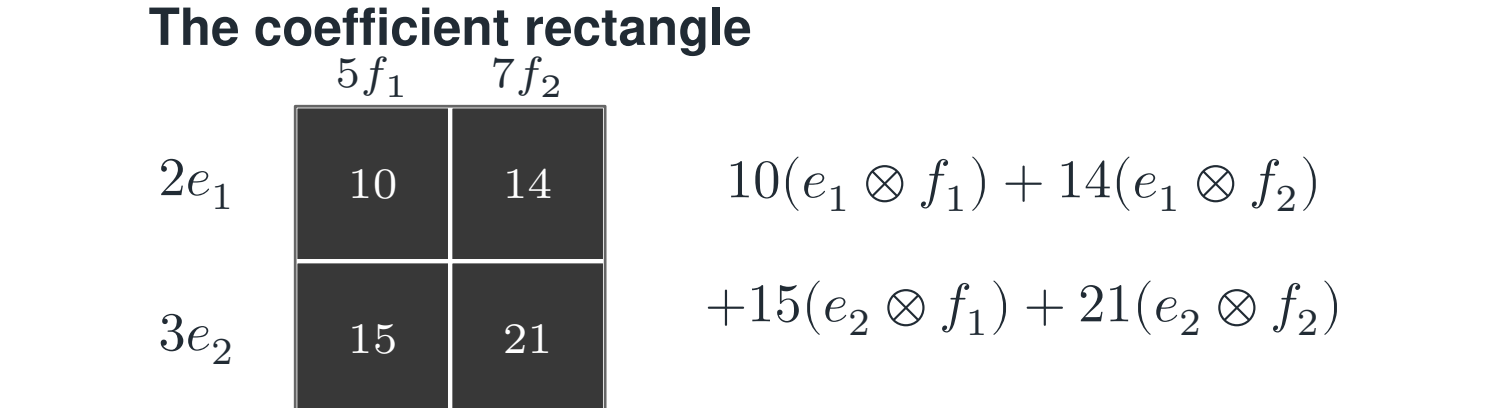
Reading the drawing
Row and column labels give the factors in the two linear combinations. The rectangular table retains both diagonal and cross coefficients; the displayed expansion below it uses all four terms.
Drawing labels and data 11 labels
Read the original labels as selectable text. Tables preserve grid relationships; other short labels are grouped compactly.
| Factors | \(5f_1\) | \(7f_2\) |
|---|---|---|
| \(2e_1\) | \(10\) | \(14\) |
| \(3e_2\) | \(15\) | \(21\) |
- \(10(e_1\otimes f_1)+14(e_1\otimes f_2)\)
- \(+15(e_2\otimes f_1)+21(e_2\otimes f_2)\)
Evidence note from the source edition
The exact expansion of \((2e_1+3e_2)\otimes(5f_1+7f_2)\). The terms away from the diagonal \(14\) and \(15\) cannot be omitted.
Keeping only the tensors with matching indices \(e_1\otimes f_1\) and \(e_2\otimes f_2\) spans a subspace of dimension two in a tensor product of dimension four. It misses both cross directions. Under scalar actions on \({\mathbb Q}^2\) and \({\mathbb Q}^2\), all four basis tensors are necessary and sufficient.
The resulting upper bound
Since simple tensors span the algebraic tensor product, the complete rectangular family proves
This is not a universal equality claim. Changing the algebra changes the answer: the full independent matrix action can make a single nonzero pure tensor cyclic. Nor does the algebraic argument itself establish a theorem for completed topological tensor products.
Read this as
The generator construction is indexed by a Cartesian product. Its proof must retain the finite double sum and the hypotheses on scalar actions that make the tensor action well defined.