
Use the ordered basis \((e_0,e_1,e_2,f_0,f_1,f_2)\). Define
Starting with \(s=e_0+f_0\), the two chains advance together:
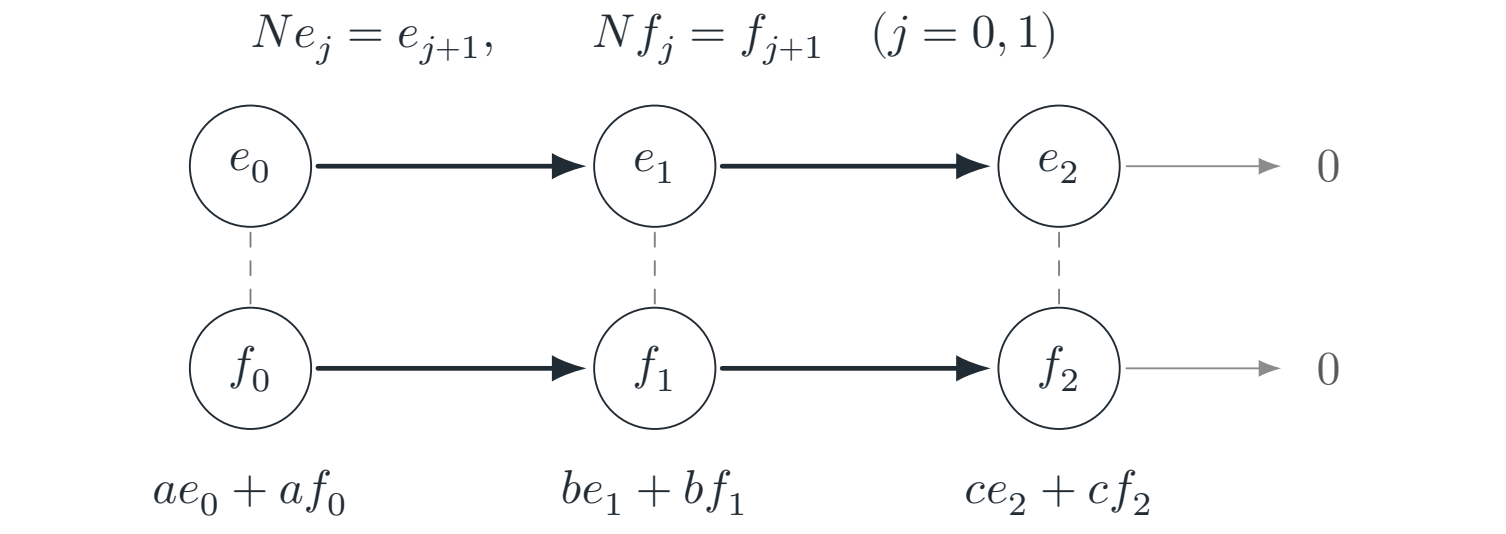
Reading the drawing
The operator advances along each of two chains and then sends the last vector to zero. Dotted vertical pairings indicate equal coefficients in the orbit of the mixed seed; they are not extra operators.
Drawing labels and data 12 labels
Read the original labels as selectable text. Tables preserve grid relationships; other short labels are grouped compactly.
- \(e_0\)
- \(e_1\)
- \(e_2\)
- \(0\)
- \(f_0\)
- \(f_1\)
- \(f_2\)
- \(0\)
- \(ae_0+af_0\)
- \(be_1+bf_1\)
- \(ce_2+cf_2\)
- \(N e_j=e_{j+1},\qquad N f_j=f_{j+1}\quad(j=0,1)\)
Evidence note from the source edition
The vertical dotted pairings record equal coefficients, not an additional allowed operator. Every polynomial in \(N\) uses the same coefficients on both chains.
Since \(N^3=0\), every polynomial orbit vector has the form
The generated hull therefore has dimension three, even though the seed has a nonzero component in each packet of dimension three. The Krylov ranks are \(1,2,3,3,3,3\).
What changes when a projector becomes admissible?
Let \(P_e\) keep the coordinates along the \(e\) chain and \(P_f\) those along the \(f\) chain. If these are merely measurement maps, the preceding hull is unchanged. If they become allowed generators, then
and powers of \(N\) now recover all six basis vectors. The same seed becomes cyclic for the larger algebra \({\mathbb Q}\langle N,P_e,P_f\rangle\).
Read this as
Nonzero components in every packet are not enough. One must also be able to separate the independent directions inside and across those packets using the allowed operations.