
Work over \({\mathbb Q}\) in
Because the relation is monic of degree two in \(y\), each element has one unique form \(a(x)+yb(x)\). The two packet coefficients are polynomials, not scalars.
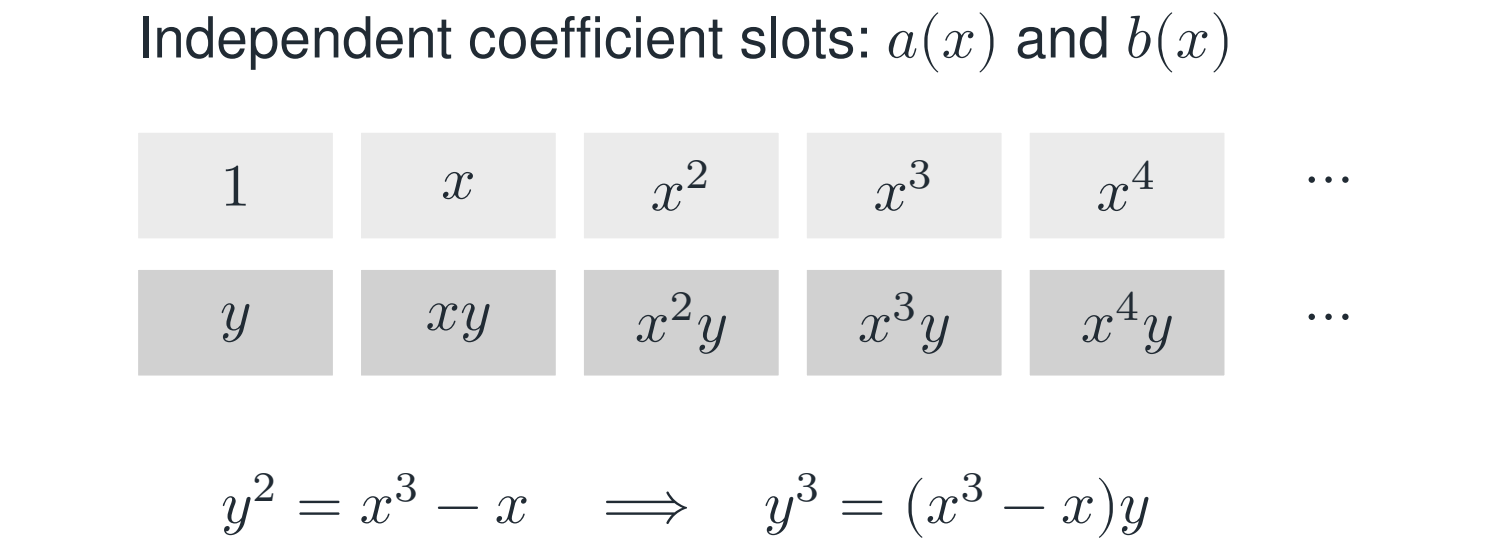
Reading the drawing
Two rows retain independent polynomial coefficient slots for a(x) and b(x). The final relation rewrites higher powers of y into these lanes rather than discarding them.
Drawing labels and data 14 labels
Read the original labels as selectable text. Tables preserve grid relationships; other short labels are grouped compactly.
- \(1\)
- \(x\)
- \(x^2\)
- \(x^3\)
- \(x^4\)
- \(\cdots\)
- \(y\)
- \(xy\)
- \(x^2y\)
- \(x^3y\)
- \(x^4y\)
- \(\cdots\)
- Independent coefficient slots: \(a(x)\) and \(b(x)\)
Evidence note from the source edition
A finite window of the two infinite coefficient lanes. Higher powers of \(y\) are rewritten using the relation. They are not simply discarded. No geometric genus or smoothness claim is encoded by this picture.
Multiplication by \(y\) transfers between the lanes
In the ordered coefficient coordinates \((a,b)\),
The entries denote multiplication maps on \({\mathbb Q}[x]\). For \(f=a_0+ya_1\) and \(g=b_0+yb_1\),
In particular,
One module seed does not mean one algebra generator
Starting from \(1\), the fixed multiplication operators \(M_x,M_y\) generate every monomial in normal form. Thus the algebra is cyclic as a module over its multiplication algebra. This does not remove either address operator, and does not say that the algebra is generated by one algebra element.
Read this as
The relation controls an exact weighted transfer between coefficient lanes. Packet reconstruction is \(a+yb\), while packet multiplication retains the weight \(x^3-x\).