
In \({\mathbb R}^2\), take
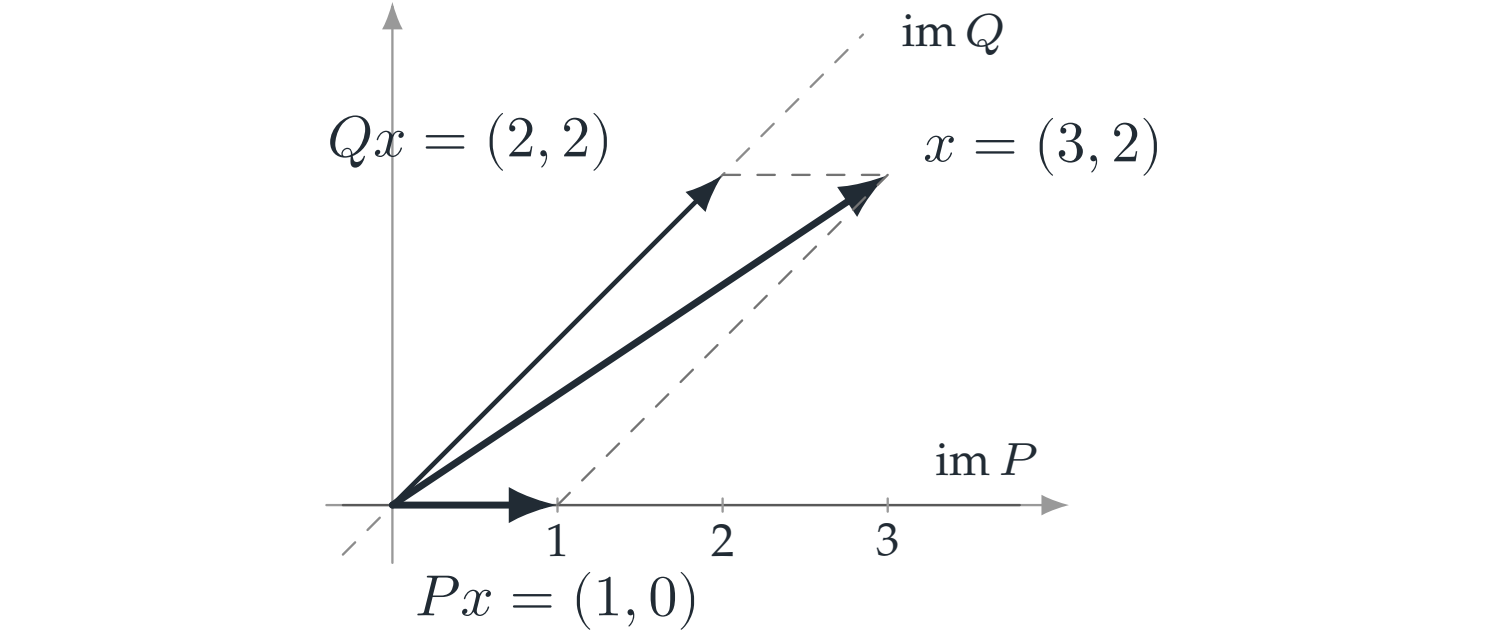
These maps satisfy \(P^2=P\), \(Q^2=Q\), \(PQ=QP=0\) and \(P+Q=I\). Their images are the horizontal line and the diagonal line, respectively. They are not selfadjoint in the usual Euclidean inner product.
Reading the drawing
A horizontal line and a diagonal line are the two packet images. The vectors Px and Qx add to x through the displayed parallelogram; their geometry is not that of perpendicular projections.
Drawing labels and data 8 labels
Read the original labels as selectable text. Tables preserve grid relationships; other short labels are grouped compactly.
- 1
- 2
- 3
- \(Px=(1,0)\)
- \(Qx=(2,2)\)
- \(x=(3,2)\)
- \(\operatorname{im}P\)
- \(\operatorname{im}Q\)
Evidence note from the source edition
Actual Euclidean vector geometry for \(x=(3,2)\). The parallelogram reconstructs \(x\) from \(Px=(1,0)\) and \(Qx=(2,2)\). Neither component is an orthogonal projection of \(x\).
Analysis records \((Px,Qx)\) and synthesis adds the two vectors. For a packet tuple \((u,v)\in{\operatorname{im}} P\times{\operatorname{im}} Q\),
Both inverse identities follow from annihilation and completeness, without any angle condition.
What the algebra does not preserve
For the displayed \(x\),
There is no Parseval identity here. The cross term is nonzero because the packet directions are not perpendicular. Likewise, the simple formula for reversing adjoints of packet blocks requires selfadjoint projectors. It is not justified for this oblique pair.
Read this as
Exact reconstruction is an algebraic inverse statement. Energy preservation and adjoint identities require additional geometric hypotheses.