
Suppose every matrix supported in a specified pattern is allowed. Then multiplication can create a new entry whenever two allowed edges compose. Let \(E_{ij}\) denote the matrix that sends \(e_j\) to \(e_i\) and kills the other basis vectors.
Reading the drawing
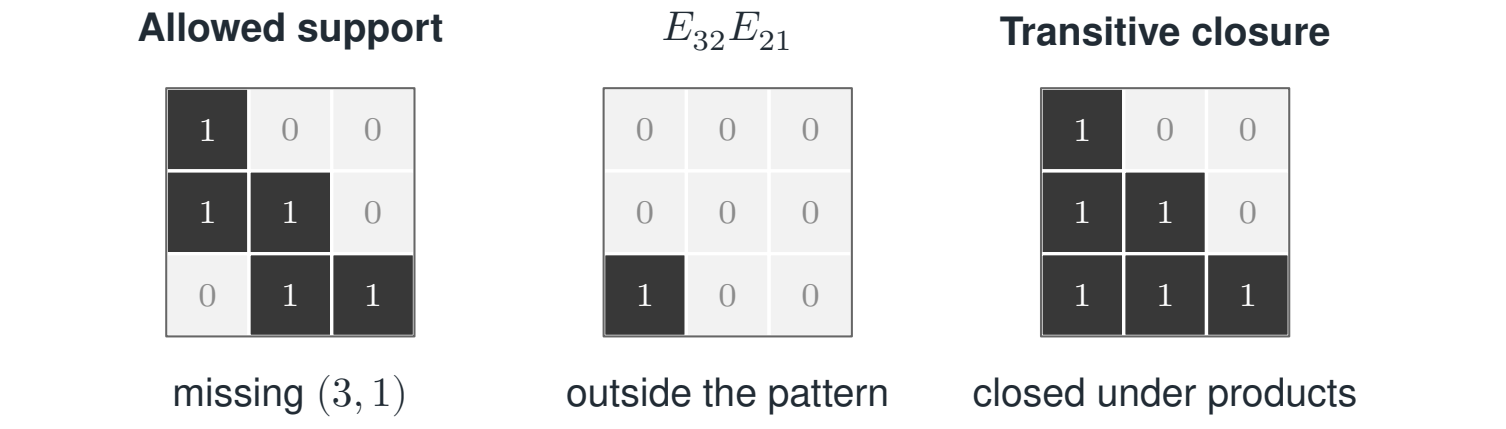
Three matrices show the allowed support, a product that escapes it, and the transitive closure. Ones in the support arrays mean allowed positions; the middle array is an actual matrix product.
Drawing labels and data 33 labels
Read the original labels as selectable text. Tables preserve grid relationships; other short labels are grouped compactly.
| Row | Column 1 | Column 2 | Column 3 |
|---|---|---|---|
| Row 1 | \(1\) | \(0\) | \(0\) |
| Row 2 | \(1\) | \(1\) | \(0\) |
| Row 3 | \(0\) | \(1\) | \(1\) |
| Row | Column 1 | Column 2 | Column 3 |
|---|---|---|---|
| Row 1 | \(0\) | \(0\) | \(0\) |
| Row 2 | \(0\) | \(0\) | \(0\) |
| Row 3 | \(1\) | \(0\) | \(0\) |
| Row | Column 1 | Column 2 | Column 3 |
|---|---|---|---|
| Row 1 | \(1\) | \(0\) | \(0\) |
| Row 2 | \(1\) | \(1\) | \(0\) |
| Row 3 | \(1\) | \(1\) | \(1\) |
- missing \((3,1)\)
- outside the pattern
- closed under products
Evidence note from the source edition
Here \(1\) means “allowed,” not that every admissible operator has that numerical value. The middle matrix is an actual product that violates the original pattern.
The first pattern contains the diagonal and permits \(1\to2\) and \(2\to3\), but forbids \(1\to3\). Yet
Both factors obey the pattern and their product does not. Thus the whole supported matrix space is not an algebra.
Reflexivity and transitivity have different jobs
The identity has a nonzero diagonal block on every nonzero packet, so including the identity requires every packet to be related to itself. Multiplicative closure requires every composite pair. Consequently, for arbitrary algebraic block maps on nonzero packet spaces,
The transitive closure in the figure is the lower triangular pattern. It does define a unital algebra.
Why this does not contradict cancellation
On Visual 9, one particular operator has cancelling paths. The support theorem asks whether multiplication works for every assignment of allowed block maps. Choosing two suitable maps of rank one removes the possibility of hiding a failed composite behind special cancellation.
Read this as
A zero pattern is a structural rule only when it survives all permitted block assignments. A coincidence in one matrix is not a closure theorem.