
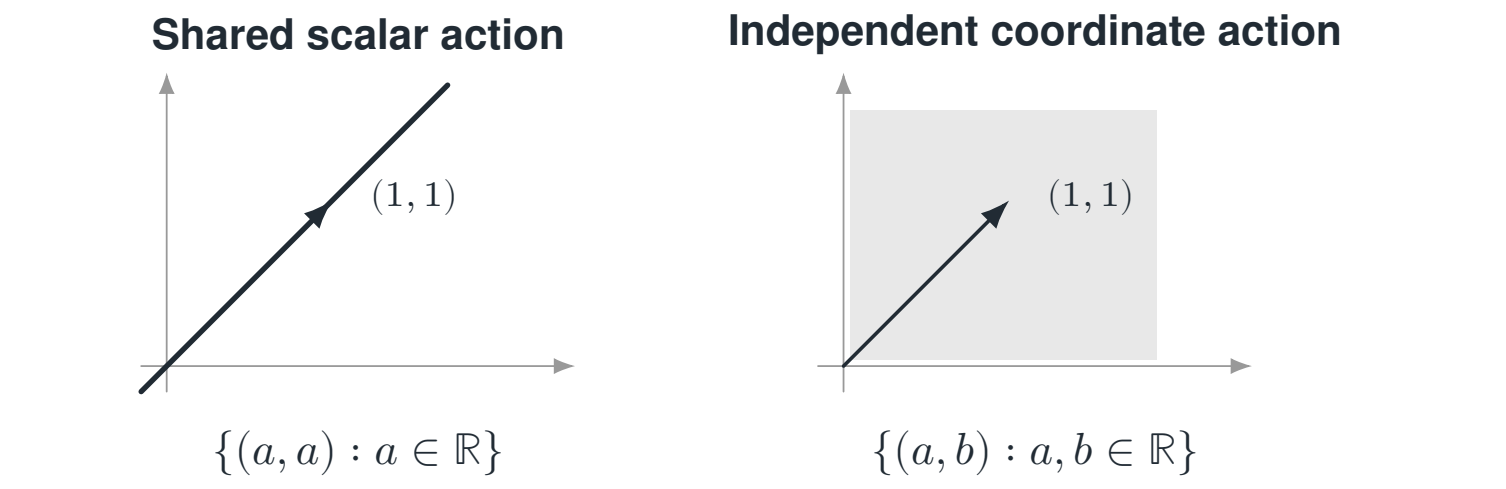
Take \(X={\Bbbk}\oplus{\Bbbk}\) and \(s=(1,1)\). With one shared scalar acting on both coordinates, every orbit vector is \((a,a)\). With independent scalars, the orbit contains every \((a,b)\).
Reading the drawing
Two panels start from the vector (1,1). Shared scalar control generates the diagonal line. Independent coordinate control generates the plane; the shaded region is only a finite window.
Drawing labels and data 6 labels
Read the original labels as selectable text. Tables preserve grid relationships; other short labels are grouped compactly.
- Shared scalar action
- \((1,1)\)
- \(\{(a,a):a\in{\mathbb R}\}\)
- Independent coordinate action
- \((1,1)\)
- \(\{(a,b):a,b\in{\mathbb R}\}\)
Evidence note from the source edition
The geometric picture uses \({\Bbbk}={\mathbb R}\). On the right, shading shows a finite window of the whole plane. On the left, only the diagonal line is generated. The algebraic distinction holds over any field.
The corresponding minimum seed numbers are
In the independent case, the algebra contains \((1,0)\) and \((0,1)\), which recover the two coordinates of \(s\) separately.
This is why the independent formula uses a maximum
For independent actions of \(\AA\) on \(X\) and \({\mathcal B}\) on \(Y\), a common list of seed positions can carry the seeds for both spaces. Pad the shorter list with zeros. Independent operators then select the two components, giving
With a shared action, this selection need not be available. The general bound is the sum.
One operator can supply independent control
Over \({\mathbb Q}\), \(T={\operatorname{diag}}(1,2)\) has polynomial projectors \(2I-T\) and \(T-I\). Thus \({\mathbb Q}[T]\) already separates the two eigenspaces. If the eigenvalues coincide, these formulas no longer separate them. Distinct primary labels play the same role on Visual 14.
Read this as
Counting occupied components is not the same as counting seeds. One mixed seed may generate several components when the algebra can act on them independently.