
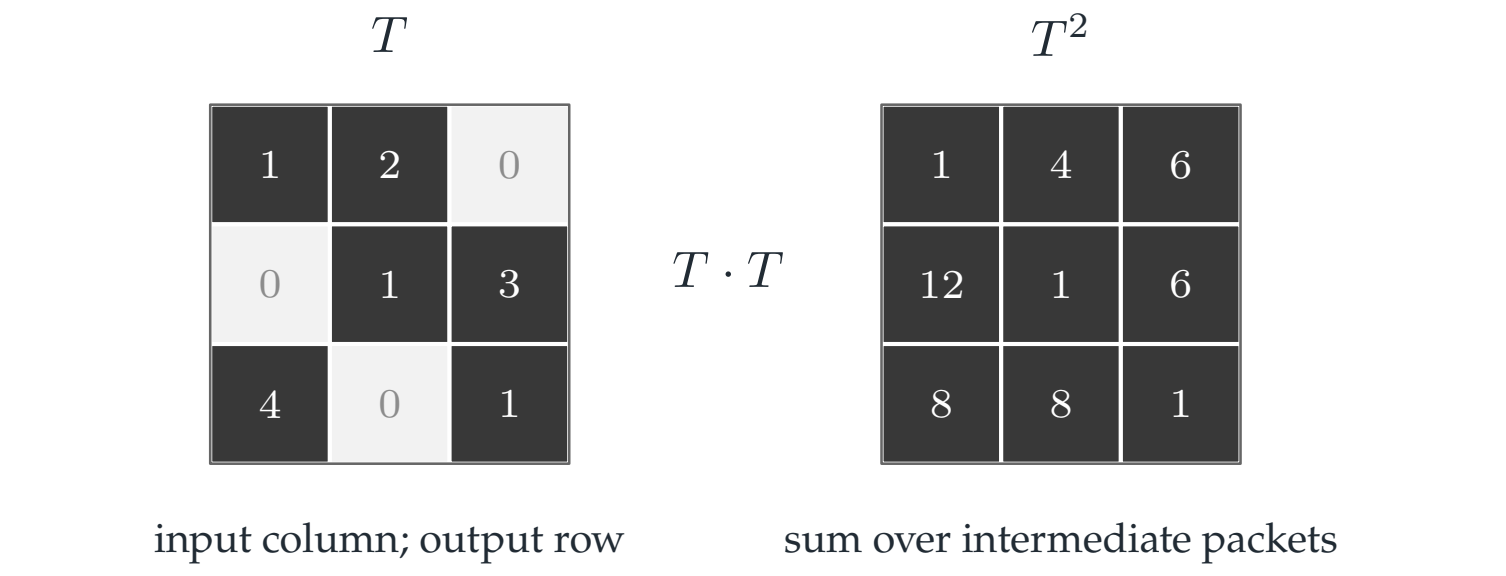
Use the three coordinate packets of dimension one in \({\mathbb Q}^3\). The block \(T_{ij}=P_iTP_j\) sends input packet \(j\) into output packet \(i\). For this example, its nonzero scalar is the \((i,j)\) matrix entry.
Reading the drawing
Two matrices show T and T squared. Rows are outputs and columns are inputs; each entry of the square sums over intermediate packet indices.
Drawing labels and data 23 labels
Read the original labels as selectable text. Tables preserve grid relationships; other short labels are grouped compactly.
| Row | Column 1 | Column 2 | Column 3 |
|---|---|---|---|
| Row 1 | \(1\) | \(2\) | \(0\) |
| Row 2 | \(0\) | \(1\) | \(3\) |
| Row 3 | \(4\) | \(0\) | \(1\) |
| Row | Column 1 | Column 2 | Column 3 |
|---|---|---|---|
| Row 1 | \(1\) | \(4\) | \(6\) |
| Row 2 | \(12\) | \(1\) | \(6\) |
| Row 3 | \(8\) | \(8\) | \(1\) |
- \(T\cdot T\)
- input column; output row
- sum over intermediate packets
Evidence note from the source edition
All displayed entries are exact integers. The square is computed from the operator, not from a thresholded graph or a matrix of block norms.
Reconstruction retains every block
The identity \(P_1+P_2+P_3=I\) gives
Selecting only the diagonal would change the operator. The entries \(2,3,4\) carry transfers between different packets.
Composition sums over intermediate packets
The \((1,2)\) entry of the square has two contributing routes:
For input \(3\) and output \(1\), only the route through packet \(2\) survives:
For packets of higher dimension, the same law uses actual linear maps as entries. The order of their composition still matters.
Read this as
An edge says a block is nonzero. The block itself carries the coefficient, sign, rank and action. A transfer graph alone does not retain those data.