
Keep the model in six dimensions, but compare two different operators:
For the same mixed seed \(s=e_0+f_0\), the Krylov matrices are different:
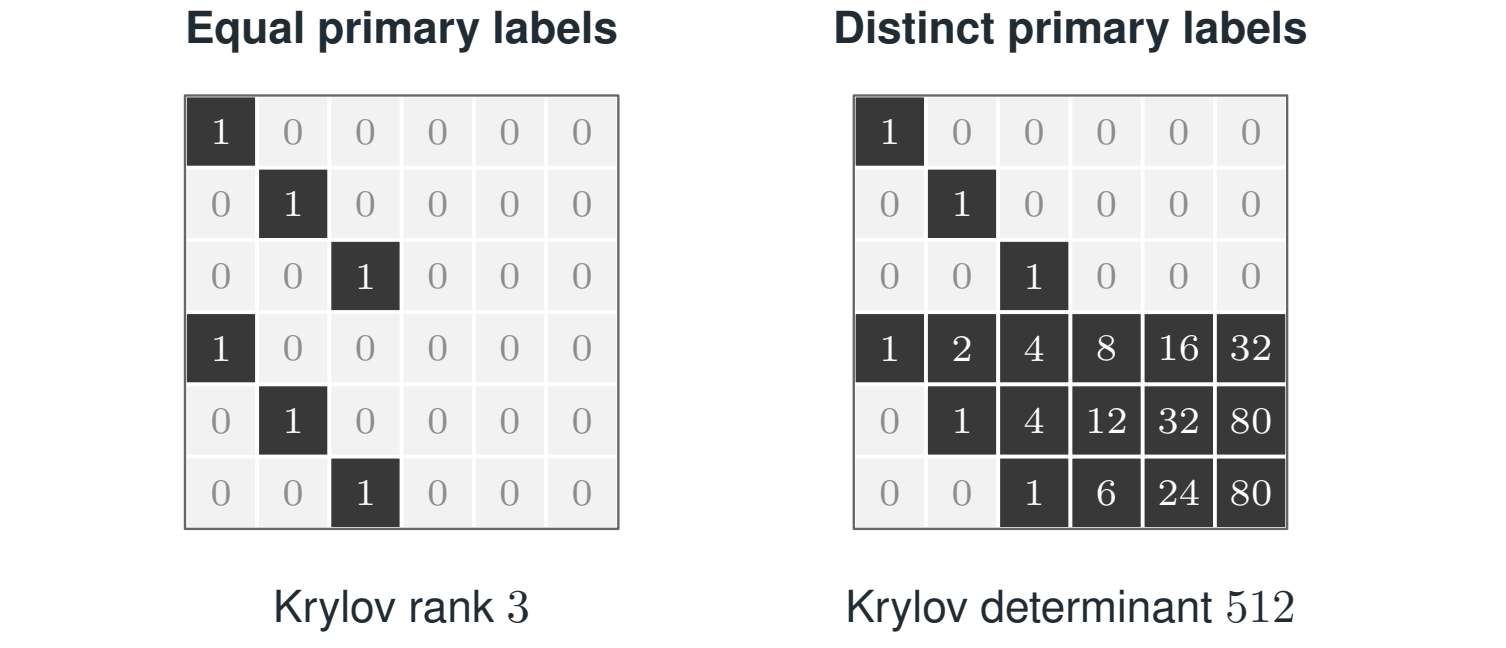
Reading the drawing
Two six-by-six matrices use the same mixed seed with different operators. Equal primary labels give rank three; distinct labels give the displayed nonzero determinant. Matrix rows run from top to bottom in the fixed chain basis.
Drawing labels and data 76 labels
Read the original labels as selectable text. Tables preserve grid relationships; other short labels are grouped compactly.
| Row | Column 1 | Column 2 | Column 3 | Column 4 | Column 5 | Column 6 |
|---|---|---|---|---|---|---|
| Row 1 | \(1\) | \(0\) | \(0\) | \(0\) | \(0\) | \(0\) |
| Row 2 | \(0\) | \(1\) | \(0\) | \(0\) | \(0\) | \(0\) |
| Row 3 | \(0\) | \(0\) | \(1\) | \(0\) | \(0\) | \(0\) |
| Row 4 | \(1\) | \(0\) | \(0\) | \(0\) | \(0\) | \(0\) |
| Row 5 | \(0\) | \(1\) | \(0\) | \(0\) | \(0\) | \(0\) |
| Row 6 | \(0\) | \(0\) | \(1\) | \(0\) | \(0\) | \(0\) |
| Row | Column 1 | Column 2 | Column 3 | Column 4 | Column 5 | Column 6 |
|---|---|---|---|---|---|---|
| Row 1 | \(1\) | \(0\) | \(0\) | \(0\) | \(0\) | \(0\) |
| Row 2 | \(0\) | \(1\) | \(0\) | \(0\) | \(0\) | \(0\) |
| Row 3 | \(0\) | \(0\) | \(1\) | \(0\) | \(0\) | \(0\) |
| Row 4 | \(1\) | \(2\) | \(4\) | \(8\) | \(16\) | \(32\) |
| Row 5 | \(0\) | \(1\) | \(4\) | \(12\) | \(32\) | \(80\) |
| Row 6 | \(0\) | \(0\) | \(1\) | \(6\) | \(24\) | \(80\) |
- Krylov rank \(3\)
- Krylov determinant \(512\)
Evidence note from the source edition
Exact rational calculations. Changing the primary label from \(0\) to \(2\) changes the operator, not merely its coordinates. The determinant on the right is \(512\ne0\).
The missing separating operation is now a polynomial
Define
These polynomials satisfy
Consequently \(p_0(T)=P_e\) and \(p_2(T)=P_f\). Applying them to \(s\) extracts both chain heads, after which polynomial powers generate all six directions. Unlike the model on Visual 3, the separating maps already belong to the polynomial grammar.
Read this as
Repeated labels can lock chains together. Distinct primary labels can admit polynomial extraction. Here the block data and extractor are explicit. No theorem asserting the existence of Jordan form is inferred from this example.