
The failure of the particular seed on Visual 3 does not prove that every single seed fails. A certificate for the lower bound does.
Define a surjective linear map
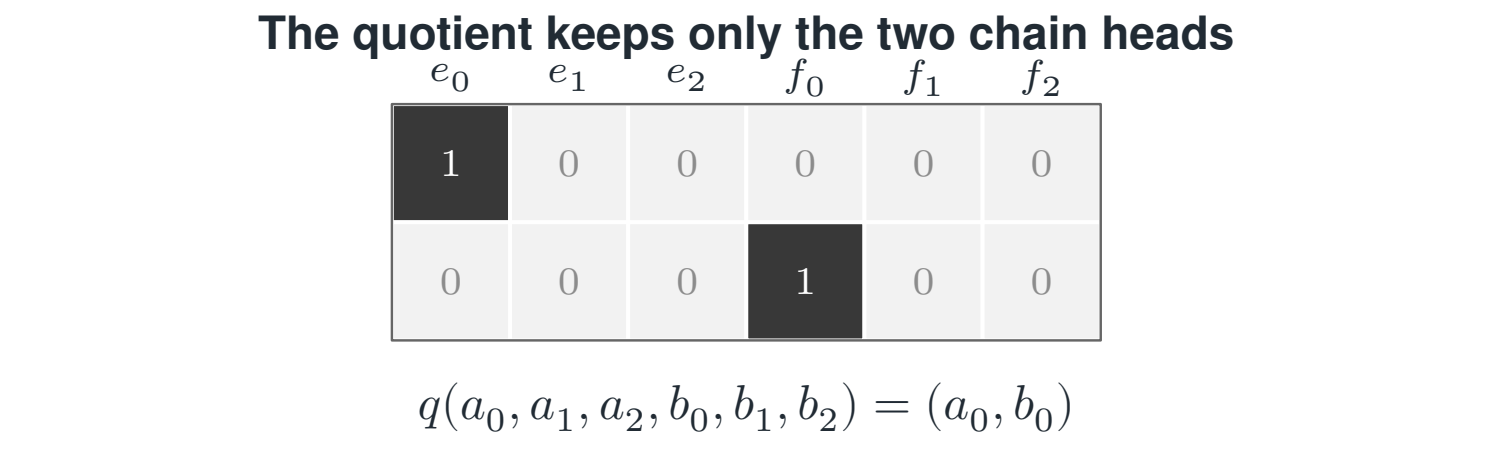
Reading the drawing
The columns of the two-by-six quotient matrix follow the displayed basis labels. Each output retains one chain head and discards its advanced positions.
Drawing labels and data 20 labels
Read the original labels as selectable text. Tables preserve grid relationships; other short labels are grouped compactly.
| Output | \(e_0\) | \(e_1\) | \(e_2\) | \(f_0\) | \(f_1\) | \(f_2\) |
|---|---|---|---|---|---|---|
| First output | \(1\) | \(0\) | \(0\) | \(0\) | \(0\) | \(0\) |
| Second output | \(0\) | \(0\) | \(0\) | \(1\) | \(0\) | \(0\) |
- \(q(a_0,a_1,a_2,b_0,b_1,b_2)=(a_0,b_0)\)
Evidence note from the source edition
An actual \(2\times6\) quotient matrix. It forgets the advanced positions in both chains and retains two independent head coordinates.
Because \(qN=0\), one has, for every polynomial \(p\),
Thus every operator acts as a scalar on the quotient. The image of the orbit of one seed stays on one line in \({\mathbb Q}^2\). It cannot span this quotient of dimension two.
Lower and upper bounds meet
If \(r\) seeds generated \(X\), their images would generate the quotient. Since scalar multiplication cannot create a new independent direction, \(r\ge2\). Conversely, the two seeds \(e_0,f_0\) generate their respective chains, so
This proof uses the displayed operator and quotient. It does not ask a computer to search every possible seed, and it does not need an existence theorem for Jordan form.
A general pattern worth recognizing
A surjective intertwiner \(q:X\twoheadrightarrow Y\) turns any generating family of \(X\) into a generating family of \(Y\). Therefore a quotient on which the grammar loses mixing power can certify a lower bound in the original, much larger space.
Read this as
To rule out one seed, find a quotient in which its entire orbit is forced onto one line while the quotient still has at least two independent directions.